
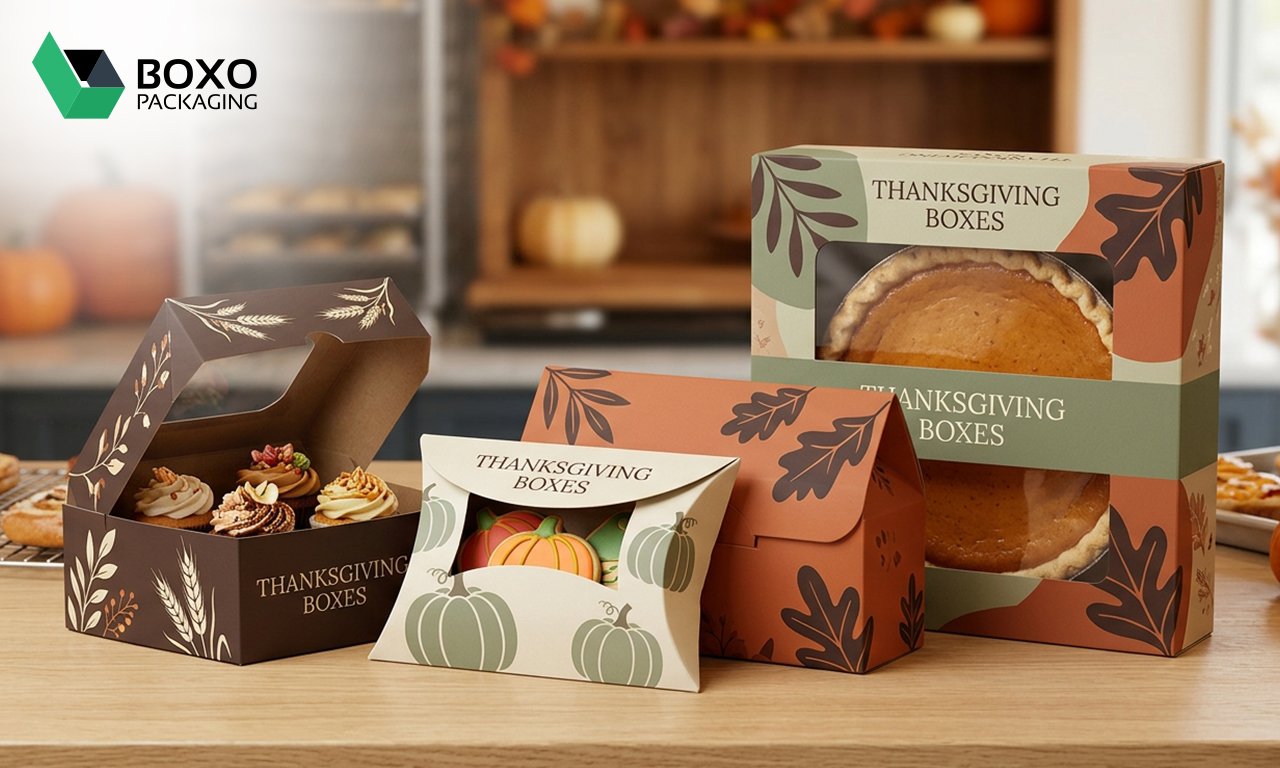
Thanksgiving boxes look like a simple seasonal purchase until the calendar gets involved. The holiday falls on the fourth Thursday of November, which in 2026 is November 26, and nearly every order tied to it has the same fixed deadline. A bakery selling pies, a caterer delivering whole dinners, a retailer shipping gift sets and a restaurant offering takeout feasts all need the right box in hand days before the first customer picks anything up. A box that arrives late, or one that fails under a hot casserole, can’t be fixed after the fact.
This article explains how to choose Thanksgiving packaging for the products you’re selling, which food safety rules affect box design, and how to plan the order so the short season doesn’t cost you.
Why the Thanksgiving window is so unforgiving
Most packaging decisions can be adjusted over time. You can reorder, switch suppliers or test a new size next month. Thanksgiving doesn’t allow that.
Demand is concentrated into a few days, and packaging has to be in place before those days begin. Food orders are usually taken in advance, production happens in a compressed stretch, and pickup or delivery clusters around Tuesday through Thursday. If a box doesn’t fit the product, there is rarely time to source a replacement.
Three things make the season harder than a typical sales peak:
- Volume is concentrated. Orders pile into a few days instead of spreading across weeks.
- Products are heavy and hot. A boxed meal can include a roasted bird, sides, gravy and pie, which stress packaging more than a typical retail item.
- Handoffs multiply. Boxes are packed, stacked, carried, loaded into vehicles and often carried again by the customer.
This is why the question is less “which box looks best” and more “which box will still be intact and safe when it reaches the table.”
Match the box to what goes inside
A Thanksgiving box is not one product. Each use case has different demands.
Pies and baked goods
Pies are the classic example of a product where fit matters more than appearance. A pie that slides inside an oversized box can crack the crust or smear the topping. Look for a box sized closely to the pie’s diameter, with enough height for domed or meringue-topped varieties, and a rigid base or board that stops flexing when the box is lifted from below.
A window can help customers confirm what they are collecting, but it also adds a place for condensation or grease to show. Consider whether the product can handle that.
Hot meals and takeout
Hot food adds steam, grease and weight. Boxes carrying sides, sauces or roasted meats need to hold up against moisture and be stiff enough that the bottom doesn’t sag when the box is carried with one hand. Venting matters too. A fully sealed container can trap steam and make crisp items soggy, while too many openings let heat escape.
For a multi-dish dinner, separate containers inside a larger outer box usually work better than loading everything loose. The outer box handles stacking and carrying, while inner containers keep dishes from running together.
Cold and perishable items
Cold sides, desserts and prepared ingredients bring a different problem: keeping temperature stable while the box sits in a car or on a porch. Outer packaging can protect against crushing and handling, but it is not a substitute for proper cold handling. If a product needs refrigeration, plan for how it will stay cold through the entire handoff, not just on the shelf.
Gifts and non-food items
Thanksgiving also drives corporate gifts, client baskets and retail sets. Here, presentation matters more, but the same fundamentals apply. The box needs to protect contents during shipping, and inserts or dividers should stop items from shifting. A gift that arrives broken is worse than a gift that arrives in plain packaging.
Food safety shapes packaging more than most buyers realize
Thanksgiving packaging doesn’t operate in a vacuum. The food inside it follows safety rules, and those rules affect how a box should be designed and used.
The U.S. Department of Agriculture advises refrigerating perishable foods within two hours of cooking, or within one hour if the temperature is 90°F or higher, according to its Thanksgiving food safety guidance. That has practical consequences for anyone selling prepared meals. A box that holds heat well may seem like an advantage, but it also means the clock keeps running while food sits inside. If customers will pick up and then travel a long distance, or let the box sit before serving, the packaging can’t fix that on its own.
It helps to be clear with customers about timing. Short, plain instructions printed on a label or card (such as when to refrigerate and how to reheat) can do more for safety than any box feature.
The same USDA guidance covers leftovers. It recommends storing them in small, shallow containers so they cool quickly, keeping them in the refrigerator for up to four days, and reheating to an internal temperature of 165°F. If your product is likely to produce leftovers, as most Thanksgiving meals are, consider including or recommending shallow containers. It’s a small addition that can matter.
Know what “food-grade” actually means
If a box or container touches food directly, the material matters. The FDA treats substances that come into contact with food, including coatings, adhesives and colorants used in packaging, as food contact substances, and they must be authorized under FDA requirements. The agency explains this in its consumer guidance on food contact substances.
In practice, that means you should ask your supplier direct questions:
- Is this box or liner intended for direct food contact?
- Are the coatings and adhesives suitable for that use?
- Can the supplier provide documentation of food-contact compliance?
Plain corrugated shipping boxes are generally intended for outer packaging, not direct contact with food. If a product will sit against the cardboard, use an appropriate liner, tray or inner container. Don’t assume that because a box is sturdy, it is also safe for direct contact with hot or greasy food.
Plan the order backward from the date
The most reliable way to avoid a Thanksgiving packaging problem is to work backward from the day customers receive the product.
Start with the pickup or delivery date, then subtract the time needed for each step: packing, production, any storage or staging, receiving the boxes, and the supplier’s production and shipping time. The logic is the same as in planning a large wholesale order for a whole home, where quantity, lead time and a buffer for surprises have to be settled before the project starts, not during it.
A few practical points:
- Order more than your forecast. Running short is usually costlier than ending up with extra.
- Seasonal packaging can often be repurposed for other fall and winter orders if it isn’t too date-specific.
- Test before committing. Pack one real order, with the actual dishes, and carry it, stack it and drive with it. A box that looks fine empty can fail when full.
- Confirm the details in writing. Dimensions, material, quantity and delivery date should all be clear before you pay.
- Allow for the unexpected. Delays, damaged shipments and miscounts happen. A buffer of a few days is worth more than a slightly lower price.
Don’t forget the delivery chain
Packaging isn’t only about the box. It’s about everything the box has to travel through. As with moving hotel furniture, where one missing item can hold up an entire room, a single missing component such as lids, inserts, labels or tape can stop a whole batch of orders.
Before the rush starts, make a simple checklist of every component each order requires: outer box, inner containers, lids, dividers, labels, bags, tape and any printed instructions. Count them against your expected orders. It’s an unglamorous step, but it prevents the most common last-minute scramble.
Common mistakes to avoid
Choosing by appearance alone. A box that photographs well but flexes under weight will cause problems.
Ignoring grease and moisture. Untreated paperboard can weaken when it meets hot, oily food.
Oversizing. Extra space lets items slide, and it wastes storage room during an already crowded week.
Skipping the test pack. The only reliable test is a real, full box.
Printing details that can’t change. If you print a specific year, price or menu on the box, any change makes the stock unusable.
Leaving customers without instructions. Reheating and storage guidance costs almost nothing to include.
If you’re short on time
Sometimes the season arrives before the planning does. If you’re ordering late, the goal is to reduce risk rather than perfect the design.
Choose stock sizes over custom ones, since standard formats are usually easier to obtain quickly. Prefer plain, versatile boxes over heavily printed ones, and add branding with labels or stickers if you want it. Confirm availability and delivery timing before placing the order, and keep a backup option in mind in case the first supplier can’t deliver in time. A modest, reliable box that arrives on schedule is worth more than an ideal one that arrives after the holiday.
Final takeaway
The most important point about Thanksgiving packaging is that the season doesn’t give second chances. Choose custom boxes based on what actually goes inside them, confirm that anything touching food is suitable for that purpose, and give customers clear timing and storage guidance. Then plan backward from the delivery date with a buffer built in.
For next year, treat this season as a record. Note which boxes held up, which sizes ran short, and when orders actually peaked. That information will make next November’s decisions faster and far less stressful.