
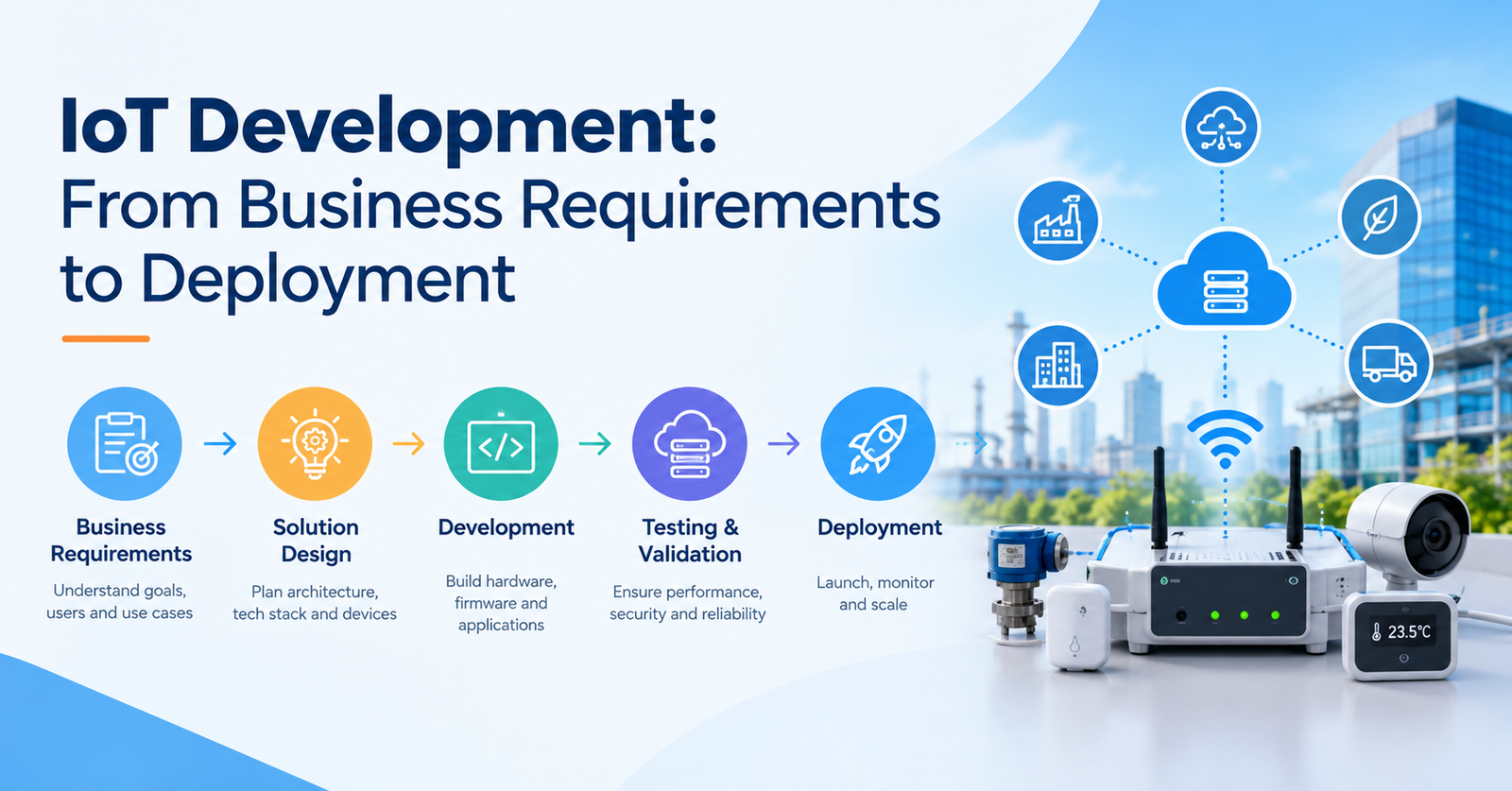
IoT Analytics counted 21.1 billion connected devices worldwide at the end of 2025, a 14% rise on the year before, and it expects 39 billion by 2030. Enterprises want in. Omdia’s 2025 IoT Enterprise Survey of 603 purchasers found that 88% see IoT as core to digital transformation and 94% expect measurable benefits within two years.
The trouble starts after the budget is approved. In Omdia’s 2026 research on edge IoT, security (31%) and integration with operational technology (29%) and legacy IT (28%) ranked as bigger obstacles than money (21%). Those are planning problems. They trace back to how a project defines requirements, picks an architecture and plans rollout. This guide walks through each stage of IoT development, from the first workshop to the first production site, so your team can spot gaps before they cost months.
Start With a Business Problem the Data Can Solve
Every successful IoT build begins with an operational question, not a sensor catalog. Write that question down before anyone picks hardware.
A good starting statement names a process, a metric and an owner. For example, “reduce unplanned downtime on filling line three by 15% within two quarters, owned by the maintenance head.” That sentence tells engineers which signals to capture, tells finance what to measure and tells operators who acts on alerts. Projects that skip it often collect large volumes of data that nobody uses. Capture the current baseline too. Without last quarter’s downtime hours, nobody can prove improvement later.
Turn Requirements Into Specifications Engineers Can Test
Vague requirements produce rework. Convert each business goal into statements that a tester can pass or fail.
- Data: Which signals, how often, and at what accuracy.
- Latency and offline behavior: How fast an alert must arrive, and what the device does when the network drops.
- Environment: Temperature, vibration, dust, power source and enclosure rating.
- Integration: Which ERP, CMMS, MES or CRM systems must receive data.
- Security and compliance: Device identity, data residency and audit needs.
- Scale: Device counts in year one and year three.
Hold workshops with operations, IT and security staff in the same room. Conflicts between those groups surface early, which is far cheaper than finding them during integration.
Choose an Architecture That Fits Each Layer
An IoT solution has four layers, and each carries its own risk. The table lists the main decision and the usual mistake at every layer.
| Layer | Key decision | Common mistake |
| Device | Sensor type, microcontroller, power source | Picking parts before the environment is known |
| Connectivity | Wi-Fi, BLE, LoRaWAN, cellular, wired | Ignoring coverage and per-device data costs |
| Edge and cloud | What to process locally and what to store centrally | Sending every raw reading to the cloud |
| Application | Dashboards, alerts, APIs, user roles | Building screens before defining user tasks |
Edge processing deserves a deliberate look. Running filters or models on a gateway cuts bandwidth and keeps a line running during an outage. In Omdia’s 2026 survey of 570 IoT decision-makers, 62% had already adopted edge architectures.
Decide Between Packaged Platforms and Custom Builds
Not every project needs bespoke code. The right mix depends on how unusual your equipment and workflows are.
Packaged platforms cover standard monitoring well. Custom IoT development services fit when you run proprietary equipment, need unusual protocols, face strict security rules or want the application to differentiate your product. Many teams combine both, using managed cloud services for ingestion and storage and custom code for device logic and business workflows. When you compare providers of IoT development services, ask each one for a reference architecture, a test plan and a named owner for post-launch support. Vendors who only talk about features tend to leave gaps in all three.
Build, Test and Secure in Short Cycles
Work in two to three-week increments, with working software at the end of each one. Test firmware on real hardware early, because simulators miss radio noise, brown-outs and sensor drift.
Run security checks in every cycle instead of once before launch. Cover unique device credentials, encrypted transport, signed firmware and least-privilege cloud roles. Then run a field trial on a small device group in the real environment for several weeks. Field trials expose problems that a lab never will, such as a metal rack that blocks a radio signal.
Deploy in Phases and Plan for Day Two
Rollout works when installers, operators and support staff each know their part. Follow a sequence like this one.
- Commission a pilot site with a small device group and a clear rollback plan.
- Train operators on the dashboard and on alert responses before go-live.
- Monitor device health, message loss and battery levels for the first 30 days.
- Fix issues, then expand site by site rather than all at once.
- Set up over-the-air updates, support tiers and a spare-device process for the long term.
Day-two operations decide whether the system lasts. Budget for them from the start.
How Kaeser Turned Compressor Data Into a Service Model
Kaeser Kompressoren, a German compressed air manufacturer with about 5,500 employees, shows what a business-first IoT project looks like.
Kaeser added IoT sensors to its compressors and moved its SAP systems to SAP HANA on HPE infrastructure, according to Tech Monitor. The aim was predictive maintenance that flags a failing part before it stops a customer’s plant. SAP’s case summary lists a core obstacle: service teams could not access calibration and equipment data held in on-premises systems.
The data also supported a new commercial model, SIGMA AIR UTILITY. Customers pay monthly for the compressed air they use, while Kaeser owns and operates the equipment, as a 2018 Springer case chapter from researchers at FAU Erlangen-Nuremberg describes. Kaeser began with a maintenance problem and a business model, then chose the technology. Buyers can copy that order.
Also Read: Custom Software Development in Houston: 10 Ways to Transform
What Return You Can Expect
Return depends on the problem you pick, so use published figures as ranges to test and not as promises.
- A paint producer using Kaeser’s connected compressors cut costs by 30,000 euros a year, as Tech Monitor reported.
- Deloitte’s 2025 Smart Manufacturing survey of 600 executives found manufacturers reporting 10% to 20% gains in production output from smart technology.
- Omdia found that 87% of respondents with edge deployments say those systems meet or exceed expectations.
Measure against your baseline at 90 days and again at 12 months. Track payback period alongside the operational metric you chose at the start.
Also Read: From Amazon to Shopify: How an E-Commerce Solutions Company
Key Takeaways for IoT Project Owners
IoT delivery succeeds or fails on preparation. Teams that tie the build to one measurable problem, write requirements a tester can pass or fail, and pay for day-two operations avoid most of the delays that Omdia’s respondents report. Match each architecture layer to a real constraint, decide edge versus cloud on purpose, and prove the design on real hardware before it leaves the pilot site. Then expand in phases, so every new site benefits from what the last one taught you.
Common Questions About IoT Development
1. How long does an IoT project take from requirements to deployment?
Published vendor estimates run from about 8 to 12 weeks for a basic monitoring build to 14 to 22 weeks for a fuller platform. New hardware adds time.
2. What causes most IoT projects to stall?
Omdia’s 2026 data points to security and integration with existing systems as the biggest causes of delays, ahead of budget.
3. What are the key stages of IoT development?
IoT development includes requirement analysis, hardware selection, connectivity planning, software development, device integration, testing, and deployment. A structured approach ensures the solution meets business needs, performs reliably, and supports future scalability.
4. How much does it cost to develop an IoT solution?
IoT development costs depend on hardware, sensors, connectivity, software complexity, cloud infrastructure, and integration requirements. Basic monitoring solutions are generally less complex, while enterprise-level platforms with custom hardware and advanced analytics require more time and investment.
5. How can businesses ensure the security of an IoT solution?
Businesses can strengthen IoT security through device authentication, data encryption, secure communication protocols, regular firmware updates, and access controls. Integrating security from the beginning and conducting regular vulnerability assessments helps protect connected devices, sensitive data, and business systems from potential threats.
Sources
- https://www.scribd.com/document/974209942/IoT-Enterprise-Survey-Summary-Report-2025-PDF-1
- https://www.themanufacturer.com/articles/how-did-german-manufacturer-kaeser-harness-internet-of-things/
- https://iotone.com/case-study/providing-a-next-generation-air-service-with-sap-reg-leonardo-internet-of-things/c1246