Artificial intelligence is becoming an important part of modern business. Companies use AI to improve customer service, analyze information, automate repetitive tasks, and develop smarter products. However, even the most advanced AI model needs accurate and well-organized data to deliver reliable results.
This is where data annotation becomes essential. Data annotation involves labeling images, videos, text, audio, and other information so machine learning models can recognize patterns and make useful predictions. For example, a self-driving vehicle needs labeled images to identify pedestrians, traffic signs, and other vehicles. Similarly, a healthcare AI system may require accurately labeled medical images to support image analysis.
Choosing the right AI Data Annotation Companies in USA can make a significant difference in the quality of your training data and the performance of your AI models. The right provider should understand your project requirements, follow consistent labeling standards, protect sensitive information, and deliver results within your timeline.
However, finding a suitable company is not always easy. Providers differ in their technical expertise, annotation methods, quality assurance processes, pricing, and ability to handle large datasets.
In this guide, we will explore what makes a data annotation company worth considering, which providers businesses can evaluate, what services to look for, and why Vision Infotech may be a suitable partner for your AI data requirements.
What Are AI Data Annotation Companies?
AI data annotation companies help businesses prepare raw data for machine learning and artificial intelligence applications. They label and organize information so that AI models can learn from examples and identify meaningful patterns.
Raw data is not always suitable for training an AI model. An image might contain several objects, a video could include multiple actions, and a text document may contain different types of information. Annotation adds the labels that explain what the data represents.
For example, a company developing a retail analytics system may need thousands of product images labeled by product category, shape, and location. An annotation provider can help create these labeled datasets according to the project’s requirements.
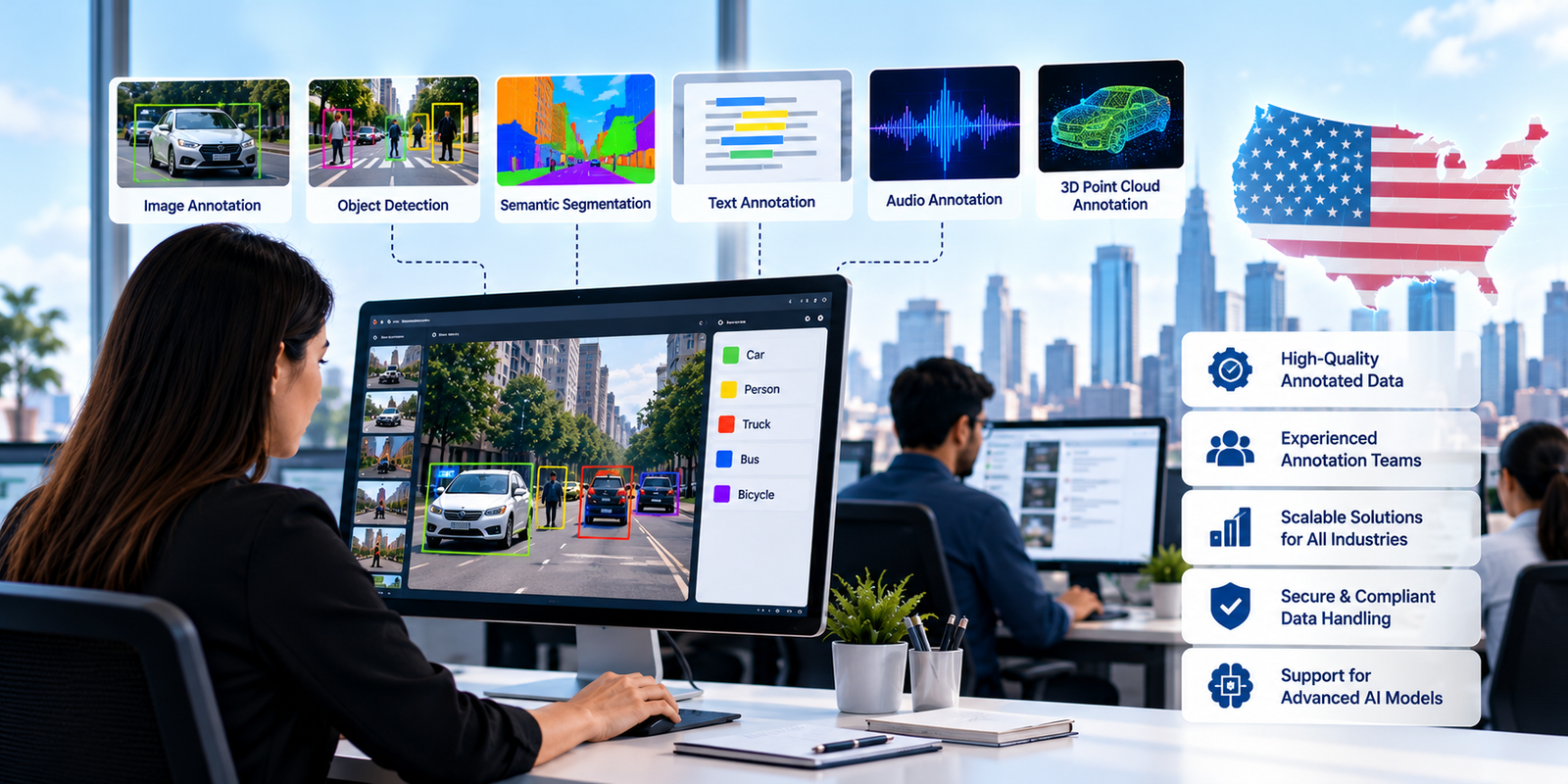
Common Types of Data Annotation
Different AI projects require different annotation techniques. Businesses should understand their needs before selecting a provider.
1. Image annotation
Image annotation involves identifying and labeling objects or regions within images. Common techniques include bounding boxes, polygons, semantic segmentation, and keypoint annotation.
These techniques support applications such as computer vision, medical image analysis, retail automation, and industrial inspection.
2. Video annotation
Video annotation involves labeling objects, movements, events, and activities across video frames. It is useful for autonomous driving, surveillance analytics, sports analysis, and activity recognition.
3. Text annotation
Text annotation helps AI systems understand written language. Tasks may include sentiment analysis, named entity recognition, intent classification, and text categorization.
4. Audio annotation
Audio annotation includes speech transcription, speaker identification, sound classification, and time-based labeling. It supports voice assistants, speech recognition, and conversational AI.
5. Data annotation for model training
Some projects combine multiple annotation methods to prepare datasets for specific machine learning tasks. The process may include labeling, validation, error correction, and formatting data for model development.
Top 6 AI Data Annotation Companies in USA to Consider
When evaluating AI Data Annotation Companies in USA, businesses should look beyond brand recognition. A provider that works well for a large autonomous driving project may not be the best choice for a startup building a document-processing application.
The following companies are worth evaluating based on their publicly known service offerings and areas of specialization. Their suitability will depend on your project’s scope, budget, data requirements, and current service capabilities.
1. Vision Infotech
Vision Infotech is a technology services company that offers AI-related services, including AI data annotation solutions. Businesses exploring AI Data Annotation Companies in USA can consider Vision Infotech when assessing potential partners for preparing training data and supporting AI development projects.
The company can be approached to discuss requirements for image, video, and other data annotation tasks, depending on the project’s scope and confirmed service capabilities.
For example, a business developing a computer vision application may need objects labeled consistently across thousands of images. A clearly defined annotation process can help the development team use these labels more effectively during model training.
Vision Infotech can be considered by businesses seeking a technology partner that can discuss their data requirements alongside their broader AI development goals.
Before starting a project, businesses should confirm the available annotation methods, expected delivery time, quality assurance process, data security arrangements, and commercial terms.
2. TELUS Digital
TELUS Digital provides digital customer experience services and AI-related solutions, including data services that support machine learning and AI development.
Its broader service capabilities may appeal to companies that need language-related data, human review, or support for AI systems serving different markets.
What to evaluate:
-
Language and regional coverage.
-
Data collection and annotation capabilities.
-
Quality assurance procedures.
-
Project management and delivery requirements.
Businesses developing multilingual applications or customer-facing AI tools may find it useful to assess TELUS Digital’s relevant offerings.
3. Appen
Appen is associated with training data services for machine learning, including data collection, annotation, and human evaluation. Its experience with language data and distributed contributor networks makes it a provider to consider for projects involving different languages and data types.
Potential use cases include search relevance, speech recognition, natural language processing, and other AI applications.
What to evaluate:
-
Availability of suitable annotators.
-
Language and domain expertise.
-
Data quality monitoring.
-
Ability to meet project-specific deadlines.
Before selecting Appen, confirm that its current services and delivery model align with your particular annotation requirements.
4. iMerit
iMerit provides data annotation and AI data services for applications that can require specialized labeling workflows. Its work has been associated with areas such as computer vision, healthcare, and other data-intensive industries.
It may be relevant to organizations that need detailed annotation rather than basic image or text labeling.
What to evaluate:
-
Experience in your industry.
-
Support for specialized annotation guidelines.
-
Quality checks and expert review.
-
Data handling and confidentiality procedures.
For projects involving complex imagery or industry-specific datasets, ask for examples of comparable work and a demonstration of the provider’s quality process.
5. CloudFactory
CloudFactory offers managed human workforce services for data-related tasks, including work that supports AI development. Businesses can evaluate its capabilities when they need structured workflows and teams to handle recurring data operations.
It may be worth considering for projects that require ongoing annotation and clearly defined review processes.
What to evaluate:
-
Workforce management and scalability.
-
Annotation consistency.
-
Delivery schedules.
-
Communication and project oversight.
Companies should confirm the exact annotation services available for their chosen project rather than assuming every data type is supported.
6. Scale AI
Scale AI is known for providing data infrastructure and data labeling services for artificial intelligence applications. Its offerings have been associated with computer vision, language models, and advanced AI development.
The company may be worth evaluating for organizations working on complex AI systems that require large datasets, specialized labeling workflows, or human feedback for model development.
What to evaluate:
-
Support for complex data annotation requirements.
-
Quality control and evaluation processes.
-
Ability to manage large-scale projects.
-
Pricing and suitability for your organization.
Scale AI may be particularly relevant to businesses with demanding AI development requirements, although smaller teams should assess whether its service model fits their budgets and project sizes.
How to Choose the Right AI Data Annotation Company
Selecting a provider requires more than comparing a few company names. The right choice depends on the data you have, the model you want to build, and the level of accuracy your application requires.
1. Understand Your Project Requirements
Start by identifying the type of data you need to annotate and the result you expect from the process.
Ask yourself:
-
Are you working with images, videos, text, or audio?
-
How much data needs to be labeled?
-
Do you need basic classification or detailed object segmentation?
-
Does your project require industry-specific knowledge?
-
What is your deadline?
For example, a retail business labeling product photographs may need image classification and bounding boxes. A company building a driver assistance system may need object tracking across video frames.
Defining these requirements helps you identify providers with relevant expertise.
2. Check Annotation Quality
Data quality has a direct impact on machine learning performance. Incorrect labels can confuse a model, introduce bias, and reduce the usefulness of its predictions.
Ask potential providers how they measure annotation accuracy and manage disagreements between annotators.
A reliable process may include sample reviews, independent validation, clear labeling guidelines, error tracking, and regular quality reports.
You should also request a pilot project before committing to a large dataset. A small test can reveal whether the provider understands your instructions and can maintain consistent results.
3. Review Industry Experience
Different industries require different annotation standards.
Healthcare projects may involve sensitive medical information. Autonomous driving requires accurate object detection and tracking. Retail applications may focus on product recognition, while financial applications may require document classification and information extraction.
Look for a provider that understands your use case and can explain its approach to difficult labeling decisions.
When comparing AI Data Annotation Companies in USA, ask for relevant case studies, sample outputs, or references where available. Make sure any claimed experience is supported by evidence.
4. Evaluate Data Security
AI training datasets can contain confidential business information, personal information, or proprietary material. Protecting this information should be a priority.
Ask the company about access controls, encryption, confidentiality agreements, data retention, and deletion procedures.
If your project involves regulated or sensitive information, check whether the provider can meet your applicable contractual and legal requirements. Do not assume that a provider is compliant with a particular regulation without verifying its documentation.
5. Compare Pricing and Delivery Time
Annotation pricing depends on several factors, including dataset size, task complexity, labeling method, review requirements, and delivery speed.
A basic classification task may cost less than detailed polygon annotation or frame-by-frame video labeling.
Rather than choosing the lowest quote automatically, compare the total cost of producing usable data. A low initial price may not represent good value if the labels require extensive correction.
Request a detailed proposal that explains the pricing model, expected turnaround, quality checks, revision terms, and any additional charges.
6. Check Scalability and Communication
Your annotation requirements may increase as your AI project develops. A suitable partner should be able to explain how it would manage changing volumes, new labeling instructions, and additional quality checks.
Clear communication is equally important. You should know who manages the project, how progress is reported, and how questions about ambiguous data are resolved.
These factors help prevent delays and reduce misunderstandings during delivery.
Key Services to Look for in an AI Data Annotation Partner
The most suitable provider should offer services that match your AI development goals. Not every project needs every annotation method, so focus on the capabilities that matter to your application.
AI Image Annotation Services in USA
Image annotation helps computer vision models understand objects, boundaries, and visual features within photographs or other images.
Common methods include:
-
Bounding box annotation: Identifies an object’s approximate location.
-
Polygon annotation: Traces an object’s outline more precisely.
-
Semantic segmentation: Assigns labels to individual pixels.
-
Keypoint annotation: Marks important points on an object or body.
-
Image classification: Assigns a category to an entire image.
For example, an agricultural technology company may use labeled crop images to train a model to recognize plant diseases. The usefulness of the resulting dataset depends on accurate labels, consistent categories, and representative examples.
When evaluating AI Image Annotation Services in USA, check whether the provider supports your required annotation format and validation standards.
AI Video Annotation Services
Video annotation helps AI models recognize objects and understand movement over time. Unlike a single image, a video contains multiple frames, so the relationship between frames is often important.
Common tasks include object tracking, action recognition, vehicle detection, and event labeling.
For example, a warehouse automation company might use annotated videos to train a system to identify forklifts, workers, and moving packages. Consistent labels across frames help the model learn how objects move through the scene.
When comparing AI Video Annotation Services, ask how the provider handles frame selection, object tracking, timestamp accuracy, and quality checks.
AI Data Annotation Services in USA
Broader AI Data Annotation Services in USA may include image, video, text, audio, and other data labeling tasks.
For a business developing a customer support assistant, annotation could involve categorizing customer questions, identifying intent, and labeling appropriate responses. For a computer vision project, the focus may instead be on object detection and segmentation.
The important consideration is whether the provider can follow your project guidelines, deliver data in the required format, and maintain quality across the dataset.
Why Accurate Data Annotation Matters for AI Development
Data annotation is not simply a preparation task. It influences how well an AI model learns from its training examples.
Better Model Performance
Consistent and correct labels help a model learn the intended patterns in the data. When labels contain frequent mistakes, the model may learn misleading relationships.
For example, a model trained to recognize vehicles may perform poorly if trucks and buses are repeatedly labeled incorrectly.
More Reliable Predictions
A well-prepared dataset can help improve prediction quality when it represents the real conditions in which the model will operate.
However, annotation quality alone cannot guarantee reliable results. Model architecture, dataset coverage, training methods, and evaluation procedures also matter.
Reduced Rework
Clear annotation guidelines and quality checks can identify mistakes before the data enters the training pipeline. This may reduce the time spent correcting datasets later.
Better Support for Business Growth
As AI projects expand, businesses may need larger datasets, new categories, or additional data types. A documented annotation process makes it easier to manage these changes without losing consistency.
Why Choose Vision Infotech for AI Data Annotation?
Businesses looking for AI Data Annotation Companies in USA should select a partner based on its ability to understand project goals, communicate clearly, and deliver data that meets agreed requirements.
Vision Infotech is worth considering if you want to discuss AI data preparation alongside your wider technology requirements.
1. A Focus on Your Project Requirements
Every AI project has different data needs. Before beginning an engagement, define the data type, labeling categories, output format, quality target, and delivery expectations with Vision Infotech.
This helps establish a shared understanding of what the project must achieve.
2. Support for Image and Video Data Needs
Computer vision projects often require detailed image labeling or annotation across video frames. Discuss your required methods with Vision Infotech to determine whether its available capabilities match your application.
A clear scope helps avoid misunderstandings about which annotation tasks are included.
3. Attention to Data Quality
A useful annotation workflow should include clear instructions, sample validation, error correction, and agreed acceptance criteria.
Ask Vision Infotech how quality will be measured for your project and whether you can review a pilot dataset before full-scale delivery.
4. Communication and Project Planning
Annotation projects can change as AI models are tested and new data requirements emerge. Discuss project milestones, reporting frequency, revision procedures, and delivery schedules in advance.
This can help your internal development team coordinate its work with the data preparation process.
5. A Technology Partner for AI Initiatives
Businesses may need several services as they develop AI products, from preparing data to integrating software and building cloud-based systems. Vision Infotech’s broader technology services may be relevant when you want to discuss related requirements with the same provider.
The exact scope, technical capabilities, security arrangements, and service terms should be confirmed before making a decision.
How to get started: Prepare a small sample of your dataset, describe the model you are developing, and list your annotation requirements. Share these details with Vision Infotech to discuss project suitability, timelines, quality expectations, and pricing.
Common Mistakes to Avoid When Selecting a Data Annotation Company
Even experienced businesses can make avoidable mistakes when outsourcing data labeling.
Choosing only by price: The cheapest provider may not deliver the required accuracy or consistency. Compare the cost of accepted, usable data rather than the initial quote alone.
Skipping the pilot stage: A small trial can reveal unclear instructions and quality issues before they affect an entire dataset.
Ignoring data security: Discuss confidentiality, access permissions, retention, and deletion before transferring sensitive information.
Using vague annotation guidelines: Instructions such as “label all important objects” can lead to inconsistent results. Define categories, edge cases, and rules for uncertain examples.
Failing to plan for revisions: Establish how errors will be reported, corrected, and reviewed before the project begins.
Assuming annotation guarantees AI success: Accurate labels are important, but model performance also depends on data diversity, training methods, and testing against realistic conditions.
Conclusion
Finding the right AI Data Annotation Companies in USA starts with understanding your project’s requirements and evaluating providers against measurable criteria. Annotation quality, technical expertise, data security, scalability, communication, and pricing should all play a role in your decision.
Companies such as Scale AI, TELUS Digital, Appen, iMerit, and CloudFactory offer different capabilities worth investigating. The best choice depends on your data type, project complexity, budget, and delivery expectations rather than company size alone.
Vision Infotech is another option to consider for businesses exploring AI data annotation and related technology services. Before making a commitment, discuss your requirements, request a sample or pilot where possible, and confirm the company’s capabilities, quality assurance methods, and security practices.
Ultimately, successful AI development begins with data that is accurate, consistent, and suitable for the task. By selecting a partner carefully and establishing clear quality standards from the beginning, your business can build a stronger foundation for machine learning projects and make better use of its AI investments.