
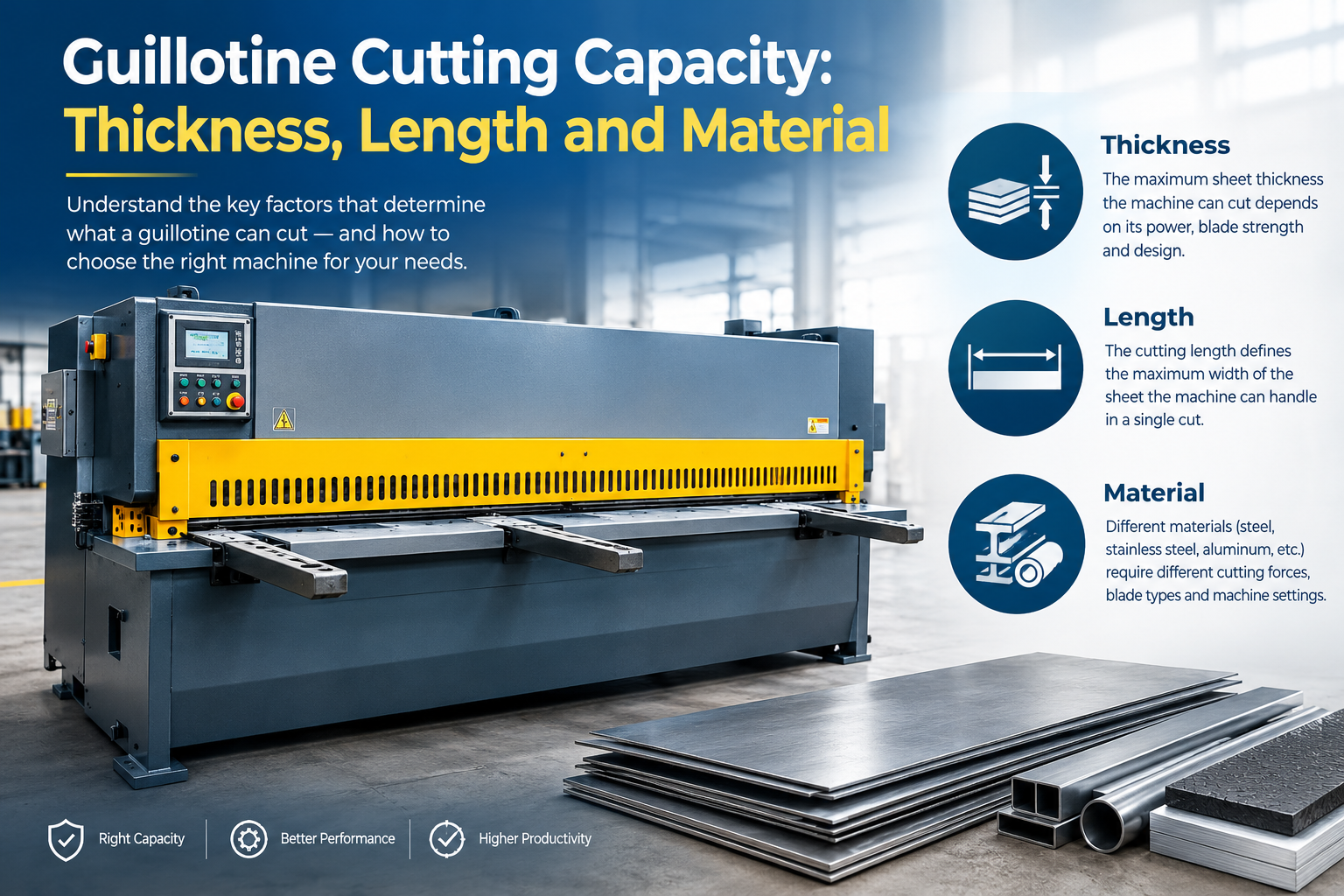
A guillotine machine might be advertised as cutting “6 mm x 3,000 mm”, but that headline figure only tells part of the story. Feed it stainless steel instead of mild steel, run it at full thickness all day, or ask it to cut narrow strips, and the real working capacity can look very different.
Understanding cutting capacity matters whether you are buying a machine, quoting a job or deciding whether an existing guillotine can handle a new material. Get it wrong and you risk poor cut quality, damaged blades or a machine strained beyond its design. This article explains what capacity ratings actually mean, how thickness, length and material interact, and how to judge whether a guillotine is right for the work in front of it.
What a Guillotine Capacity Rating Really Means
A guillotine machine shears sheet metal between a moving upper blade and a fixed lower blade. Its capacity is usually expressed as two figures: the maximum thickness it can cut and the maximum cutting length.
The thickness figure is almost always based on mild steel of a stated strength. Manufacturers typically quote a reference tensile strength alongside it, and that detail matters. A machine rated at 6 mm in mild steel is not a 6 mm machine for every material. It is a machine with enough force, frame stiffness and blade strength to shear mild steel of that thickness along its full cutting length.
The length figure is the usable blade length. Some machines can cut slightly longer than this by passing the sheet through a gap in the frame, but most standard guillotines can only cut sheets up to the blade length in a single stroke.
How Thickness Affects Cutting Force
Thickness has a bigger effect than many people expect. On a guillotine with an angled (raked) upper blade, the force needed rises roughly with the square of the material thickness. Doubling the thickness therefore needs around four times the force, not twice as much.
This is why a small increase in thickness can push a job from comfortable to impossible. A machine cutting 4 mm mild steel with ease may struggle badly at 6 mm, even though the difference sounds modest.
The blade rake angle also plays a part. A steeper rake reduces the force needed because the blade engages the sheet progressively, but it increases bow and twist in the cut piece. A shallower rake gives flatter parts but demands more force. Machines with adjustable rake let operators balance these two effects for each job.
Minimum Thickness Matters Too
Capacity is not only about the maximum. Very thin sheet can fold or tear between the blades if the blade gap is set for thicker material. Most guillotines need the gap adjusted to suit the thickness being cut, either manually or automatically through the control system.
How Material Type Changes Real Capacity
Because ratings are based on mild steel, any stronger material reduces the maximum thickness a machine can cut. Weaker materials may allow a little more, within the limits of the blade gap and hold-down system.
Stainless Steel
Stainless steel is stronger than mild steel and work hardens as it is cut. As a result, the stainless capacity of a guillotine is usually well below its mild steel rating. A commonly quoted rule of thumb is around two-thirds of the mild steel figure, but this varies with grade and machine design. Always use the manufacturer’s capacity chart rather than relying on a general rule.
Aluminium
Many aluminium alloys are softer than mild steel, so a machine can often cut them at or above its mild steel thickness. However, aluminium alloys vary widely. Harder tempers behave differently from softer grades, and soft aluminium can smear or leave a poorer edge if the blade gap is not set correctly.
Other Materials
Copper, brass and galvanised steel are commonly cut on guillotines, each with its own capacity limits. Coated or pre-painted sheet may need protective measures to avoid marking.
High-strength and wear-resistant steels are a different matter. Their strength can far exceed that of mild steel, and many standard guillotines are not designed to cut them at any useful thickness. Check with the manufacturer before attempting it, as the result can be damaged blades or a damaged machine.
Guillotines are also designed for flat sheet. Bar, angle, tube and other sections need dedicated cutting equipment.
Cutting Length and Sheet Size
Cutting length determines the widest sheet a machine can cut in one stroke. In the UK, common sheet sizes include 2,500 x 1,250 mm and 3,000 x 1,500 mm, so many workshops choose a machine slightly longer than the widest sheet they handle.
Length and thickness are linked. A guillotine’s rated thickness applies along its full cutting length, and the machine’s frame and blade beam are designed around that combination. A longer machine needs a stiffer structure to cut the same thickness without deflection, which is one reason longer, heavier-capacity machines cost more.
Length also affects handling. Long, heavy sheets need front supports and safe loading methods, and cut parts need somewhere to go at the rear of the machine.
Practical Factors That Reduce Usable Capacity
A guillotine’s rated capacity describes what it can do in good condition, set up correctly. Several factors reduce what you can achieve in practice.
- Blade condition: worn or chipped blades need more force and produce rougher edges, burrs and distortion.
- Blade gap: a gap set too wide for the material leaves burrs, while one set too tight increases blade wear and load.
- Narrow strips: cutting thin strips from thick sheet increases bow, twist and camber, so the practical minimum strip width rises with thickness.
- Duty cycle: cutting at maximum thickness all day accelerates wear. Many operators prefer a machine with some capacity in reserve.
- Machine condition: older machines, especially those with worn guides or hydraulic components, may not achieve their original rating.
Some modern machines record stroke counts and settings, making it easier to plan blade maintenance. This reflects a wider move towards connected machinery, similar to the approach described in IoT development from business requirements to deployment.
A Worked Example: Matching a Machine to the Job
Imagine a workshop that regularly cuts 3 mm mild steel and occasionally 3 mm stainless steel, using sheets up to 3,000 x 1,500 mm.
- Find the strongest material. Stainless steel is the limiting material, not mild steel.
- Convert to a mild steel equivalent. Using the two-thirds rule of thumb, 3 mm stainless steel suggests a machine rated at around 4.5 mm in mild steel. The manufacturer’s chart should confirm the exact figure.
- Allow some headroom. Rather than working at the limit, the workshop might look at a 6 mm machine.
- Check the length. Cuts across the 1,500 mm width fit most machines, but full-length cuts on 3,000 mm sheets need a machine of at least that length.
This approach avoids the common trap of choosing a machine by its mild steel rating alone, then discovering it cannot handle the stainless work.
Common Mistakes When Judging Guillotine Capacity
- Treating the headline figure as universal: the rated thickness applies to mild steel of a stated strength, not every material.
- Ignoring material certificates: two sheets of the same nominal grade can differ in strength, which affects cutting force.
- Forgetting future work: buying exactly enough capacity for today can leave no room for thicker or stronger materials later.
- Overlooking blade gap settings: good capacity on paper means little if the gap is wrong for the job.
- Cutting unsuitable materials: hardened plate and sections can damage blades and machines.
Safety and Capacity
Working within a machine’s capacity is also a safety issue. Overloaded guillotines can damage blades and components, and poor-quality cuts often lead to more handling of sharp, distorted parts.
In the UK, the Provision and Use of Work Equipment Regulations 1998 (PUWER) require work equipment to be suitable for its intended use, properly maintained and used only by people who have received adequate training. Using a guillotine within the manufacturer’s stated capacity and following its instructions is part of meeting those requirements.
Final Takeaway
A guillotine machine’s capacity is a combination of thickness, length and material, not a single number. The rated thickness is a mild steel figure, and it falls significantly for stronger materials such as stainless steel. Force rises sharply with thickness, and blade condition, blade gap and strip width all affect what you can achieve day to day.
Before choosing or using a machine, identify the strongest material and largest sheet you need to cut, check the manufacturer’s capacity chart for that material, and leave some headroom. That simple process prevents most capacity problems before they start.