
Digital landscapes are changing at an unprecedented rate in the UAE. The Internet is viewed by their customers through various devices, including smartphones, tablets, laptops and even smart TVs; businesses cannot afford to give a single website experience. From a person looking to buy online, make an appointment, or find out more about a business, quick page load times, correct display and smooth operation on all devices are expected throughout the entire time spent on a website.
This change has taken responsive websites to the condition where organisations have to have it as a need instead of an enhancement. While the year 2026 brings with it new customer trends, fresh search engine results, and rising competition, businesses are investing in digital experiences to keep up. Those businesses that fail to be responsive will risk losing potential customers before they can even attract them.
Let’s dive in and see why responsive design has become a valuable asset for businesses to grow in the UAE.
What is Responsive Web Design?
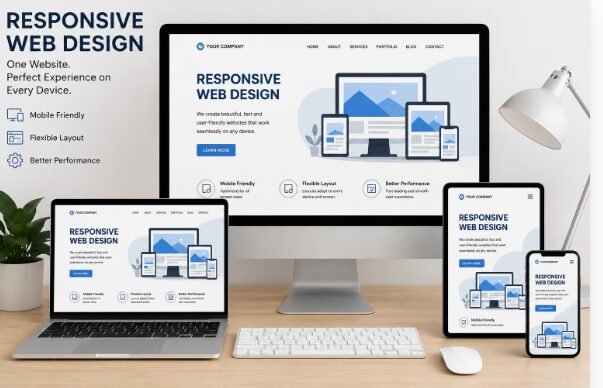
Responsive Web Design is the process of designing websites that conform to various screen sizes and types of devices. In a responsive website, rather than creating two separate sites for mobile and desktop use, they will use flexible layouts, resizable images, and adaptable navigation to provide the best available user experience in any scenario.
The result is that visitors will experience the same level of functionality from their smartphones in the train as well as their desktop computer in the office.
The Rise of AI Search and Its Impact on Responsive Design in 2026
One of the biggest shifts shaping web design in 2026 is the rise of AI-powered search engines and answer systems such as Google AI Overviews, ChatGPT-style assistants, and voice-driven search interfaces. Users in the UAE are increasingly relying on these tools to discover businesses, compare services, and make quick decisions without visiting multiple websites.
In this environment, responsive web design plays a direct role in how well a website is interpreted, displayed, and ranked by AI systems.
AI-driven search engines prioritize websites that offer:
- Clean, structured layouts
- Mobile-first performance
- Fast loading speeds
- Clear content hierarchy
- Strong usability signals
A responsive website naturally supports all of these requirements because it is built to adapt seamlessly across devices and screen sizes.
For UAE businesses, this means that responsiveness is no longer just about user experience—it is also about AI visibility. Websites that fail to load properly on mobile devices or provide inconsistent layouts risk being ignored by AI search summaries, resulting in reduced organic traffic and missed business opportunities.
Mobile Usage Continues to Dominate in the UAE
The UAE has been one of the nations conventionally cited as having a significantly high density of smartphones. Consumers access the web on mobile devices for virtually everything online, including:
- Shopping
- Banking
- Booking appointments
- Ordering food
- Comparing products
- Reading reviews
- Contacting businesses
With the rising amount of mobile traffic, sites optimised for a desktop are needless barriers. Small fonts, skewed designs, slow loading pages, and hard-to-navigate sites quickly lose people, and they never come back!
However, responsive websites eliminate all of these problems and ensure that businesses can give their visitors a wonderful experience that will keep them remaining on the site longer and racking up the desired actions.
The UAE is one of the most digitally connected countries in the world, with extremely high smartphone penetration and strong internet infrastructure. This creates a unique environment where user expectations are significantly higher than global averages.
Consumers in Dubai, Abu Dhabi, Sharjah, and other emirates are highly accustomed to fast digital experiences.
If a website fails to meet these expectations, users are quick to abandon it and switch to competitors. This is especially critical in industries such as real estate, tourism, hospitality, and e-commerce, where customer decisions are often made within seconds.
Responsive web design directly addresses these expectations by ensuring that every interaction feels smooth, professional, and reliable across all devices.
The Greater the User Experience, the Greater the Customer trust.
Elucidating a first impression is quickly done online. Factors such as a company’s professional appearance and dependability can be assessed within a few seconds by their viewer.
This positive impression can be further aided by a responsive website that provides the following:
- Fast-loading pages
- Easy-to-read content
- Simple navigation
- Appropriately sized, touch-screen-friendly buttons.
- Productively branding a product across all devices. Productively branding devices consistently.
A business that is easily accessible without customers having to zoom, scroll along the side or wait for pages to load builds customers’ trust in that business.
Convenience can be what sets you apart in the competitive UAE markets where customers have plenty of options to choose from.
Mobile-friendly websites benefit from better search engine rankings
These days, user experience matters in search engines and is a crucial factor in determining search engine results. This is the reason for considering responsive design as an integral component of good SEO practice.
The Search Engines take into account the following:
- Mobile friendliness
- Page loading speed
- Core Web Vitals
- Bounce rate
- User engagement
- Accessibility
A responsive site provides a boost to so many of these ranking factors – it performs well in so many ways! Businesses also gain from having only one URL structure, being indexed more easily and avoiding issues of duplicate content.
Organic traffic is the primary source of leads for businesses, and higher search visibility means that they will be able to get those leads without paying for advertising.
Increased conversion rates on all devices
Optimisation of traffic for a website is not all. Its ultimate goal is to turn visitors into customers.
Responsive websites boost their conversion rates since they eliminate customer obstacles along the way. Depending on what users want to do:
- Submit an enquiry.
- Make a purchase
- Schedule a consultation
- Download a brochure
- Contact customer support.
They can play with them with ease from all devices.
Simple forms, responsive buttons, optimised checkout processes, and intuitive navigation all help increase revenue.
Cities like Dubai feature healthcare, real estate, retail, hospitality, educational, and financial services among the top sectors for businesses, and a small boost in conversion can translate into significant business expansion.
Faster Websites Mean Happier Visitors
The speed of your website has a direct impact on the customer satisfaction level.
A modern responsive website employs the following:
- Optimised images
- Flexible layouts
- Efficient coding
- Browser caching
- Compressed resources
These enhancements help lessen load times on varied devices and networks.
Websites that take longer to load experience the same problems – research after research has recorded the fact that visitors leave websites that are slow to respond. Each second that passes puts you at risk of losing potential customers before they get in touch with your business.
Consistent and smooth brand experience everywhere
Customer engagement happens at several touchpoints with several devices during the day.
The typical journey will consist of:
- Discovering companies via social media using a smartphone.
- Looking up information on a computer at work.
- Using the tablet for purchasing
- Contacting customer support from a desktop
With responsive design, all the interactions are familiar and consistent.
Whether a user is on a tablet, smartphone, or desktop, all pages of a website utilise the same colours, fonts, graphics, menus, and tone, which promotes brand recognition and polishing the digital look.
Responsive websites support accessibility by ensuring:
- Text remains readable across all screen sizes
- Buttons and navigation are easy to interact with on touch devices
- Content adjusts for screen readers and assistive technologies
- Layouts remain structured and logical regardless of device
A non-responsive website can unintentionally exclude users by making navigation difficult or content unreadable on smaller screens. On the other hand, a responsive and accessible design ensures equal access to information and services, strengthening brand reputation and customer trust.
More value for the future and less maintenance.
Separate homepages on computers and cell phones make building and managing content harder, create duplicate maintenance, and raise dollars needed to develop.
Responsive websites make it easy to operate by offering the following:
- This page could be used to control a single website.
- Faster content updates
- Easier security maintenance
- Simplified analytics
- Reduced development expenses
As technology continues to progress, responsive frameworks are more simple to customise to support additional devices without having to start over and build out a different website.
This means that you do not have to spend extra resources on creating multiple layouts for different devices.
Planning for Future Technologies
The transformation of digital innovation is going by at a lightning-quick rate. Customers are now visiting web properties on foldables, wearables, voice-to-speech devices, and displays with high resolutions.
Responsive design means that it’s flexible, which is better for newer technologies getting implemented than being built on an inflexible old wide, fixed design.
Future-ready websites are also better equipped for AI-driven search experiences. As AI becomes a larger part of how people discover businesses online, companies investing in responsive websites alongside AI SEO services ensure their content remains accessible, crawlable, and optimised for emerging search technologies.
They who invest will have a better business tomorrow to cope with the changes without the need for redesigns every few years.
Future-ready websites will contribute to sustainable growth in the digital realm and will continue to serve the users in line with their evolving behaviour.
Why Responsiveness design is a must-have in 2026 for UAE businesses?
Embracing a digital-first approach has helped the UAE’s digital economy thrive across sectors, from retail, tourism, logistics, and healthcare to education, finance and professional services, etc.
Today, customers are more and more demanding that websites will provide the following:
- Instant loading
- Mobile optimisation
- Secure browsing
- Easy navigation
- Fast communication
- Seamless purchasing experiences
If these expectations aren’t met, then before you have any real chance at customer interaction, you’ll lose the trust of your customers.
Responsive websites make a better impression, bolster customer satisfaction and are a key ingredient in achieving long-term digital success – local or international.
Collaborating with professionals who are familiar with best practices in modern website usability as well as changing search engine trends can help businesses build websites that will be competitive well into the future.
Responsive web design should not be viewed as a one-time upgrade but rather as a long-term investment in digital growth. As new devices continue to emerge—foldable phones, smart TVs, wearable screens, and AI-powered interfaces—responsive frameworks ensure that websites remain adaptable without requiring constant redesigns.
This future-proofing is especially valuable for UAE businesses aiming for sustainable growth in a rapidly evolving digital economy.
Instead of rebuilding websites every few years, businesses with responsive design foundations can easily scale, optimize, and expand their digital presence with minimal disruption.
Conclusion
In 2026, responsive web design is no longer an optional feature—it is a fundamental requirement for success in the UAE’s digital-first economy. With users accessing websites across multiple devices, expecting instant performance, and relying increasingly on AI-driven search, businesses must ensure their digital presence is flexible, fast, and user-focused.
The responsive website is not just a matter of design anymore; it is an integral component of any business. With digital competition ramping up in the UAE, businesses must have websites that interact consistently on any screen, deliver improved user experiences, improve on search engine visibility.
When investing in responsive web design today, businesses are building a better base from which to grow into tomorrow and will be able to continue catering to their customers where and how they decide to go. When paired with a well-planned digital approach and consistent ongoing SEO initiatives, a responsive website can be one of the most formidable and enduring assets that any UAE business has in their arsenal for years to come.
A responsive website not only improves user experience but also strengthens SEO performance, increases conversions, supports accessibility, and builds long-term brand trust. More importantly, it ensures that businesses remain competitive in a market where customer expectations continue to rise.
For UAE businesses aiming to grow, scale, and stay relevant, investing in responsive web design is one of the most strategic decisions they can make. It is the foundation upon which future-ready digital experiences are built—and the difference between being visible or invisible in an increasingly crowded online world.
