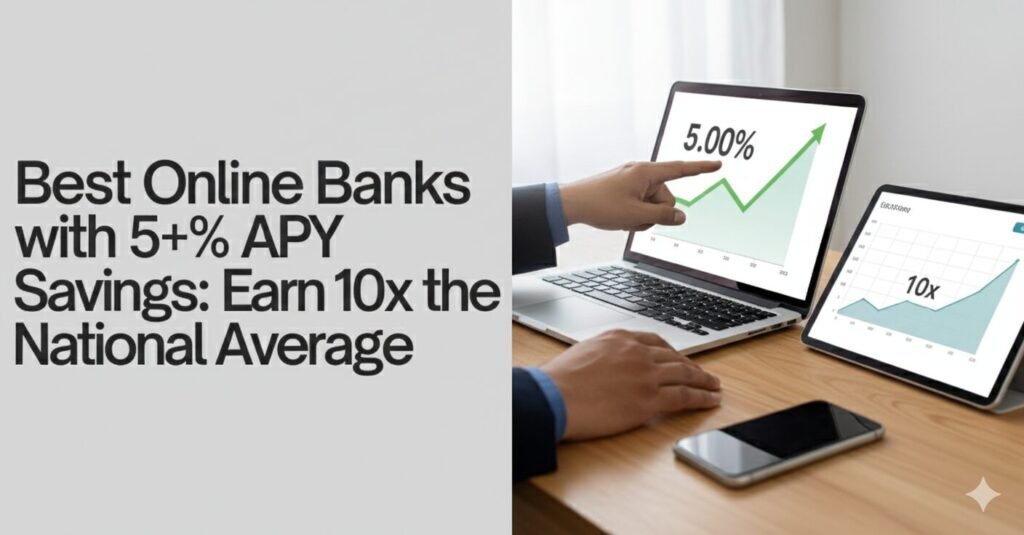
Online banks now offer up to 5% APY on savings accounts—more than 10 times the national average of 0.40%—helping your money grow faster without locking it away in CDs or investments.
Quick Facts About High-Yield Savings Accounts
| Account Feature | Details |
|---|---|
| Highest APY Available | Up to 5.00% (Varo Savings) |
| National Average APY | 0.40% (FDIC data) |
| Typical APY Range | 3.30% to 5.00% |
| FDIC Insurance | $250,000 per depositor, per bank |
| Monthly Fees | $0 (most high-yield accounts) |
| Minimum Opening Deposit | $0 to $1,000 depending on bank |
| Interest Compounding | Daily (credited monthly) |
| Withdrawal Access | Anytime with no penalty |
Understanding High-Yield Savings Accounts
High-yield savings accounts pay you significantly more interest than traditional bank savings accounts. The difference is dramatic—on a $10,000 balance, the national average earns you $40 per year, while a 5% account generates $500 annually.
Online banks offer these higher rates because they skip expensive branch networks. Lower overhead costs mean they pass savings directly to you through better interest rates. You get the same FDIC insurance protection as traditional banks, just with much better returns.
Your money stays liquid and accessible. Unlike certificates of deposit (CDs) that lock your funds for months or years, you can withdraw from savings accounts whenever you need cash. There’s no early withdrawal penalty eating into your earnings.
Top Banks Offering 5%+ APY
Varo Bank Savings Account
Varo pays up to 5.00% APY on balances up to $5,000. This represents the highest rate available from a mainstream online bank right now.
You must meet two requirements to earn the 5% rate. First, receive at least $1,000 in direct deposits each month. Second, maintain a positive balance in both your Varo Bank Account and Varo Savings Account at month’s end.
Balances above $5,000 earn 2.50% APY—still far better than traditional banks. You pay zero monthly fees and face no minimum balance requirements. Varo operates as a full-service online bank with checking, savings, and credit-building products.
The Varo mobile app includes automatic savings tools. Save Your Pay transfers a percentage of your paycheck directly into savings. Save Your Change rounds up checking purchases to the nearest dollar and moves the difference into savings.
Newtek Bank High-Yield Savings
Newtek Bank offers 4.35% APY with no balance cap. Every dollar in your account earns the same high rate, whether you save $100 or $100,000.
You need zero dollars to open your account. There’s no minimum opening deposit requirement. Monthly maintenance fees don’t exist with this account.
Interest compounds daily and posts to your account monthly. This means your earnings start generating their own interest immediately. The account is FDIC-insured up to standard limits.
Newtek operates primarily online. Customer service is available by phone during business hours. The bank’s website and mobile app give you 24/7 account access.
Axos Bank ONE Savings
Axos Bank pays up to 4.31% APY on your complete balance. The rate applies to accounts of any size with no tiered structure or balance caps.
You can open an account with just $1. No monthly fees reduce your earnings. Interest compounds daily, helping your money grow faster through the power of compounding returns.
Axos provides a free ATM card with your savings account. You get unlimited domestic ATM fee rebates, making cash access convenient nationwide. The bank’s mobile app earns high ratings for its user-friendly interface and features.
Security features include two-factor authentication, biometric login, and real-time fraud monitoring. Your deposits are FDIC-insured for full protection.
Banks Offering 4%+ APY
Western Alliance Bank High-Yield Savings Premier
Western Alliance Bank delivers 4.20% APY on all balances. You need a $500 minimum deposit to open your account, but after that, a balance of just $0.01 earns the advertised rate.
This bank operates as part of Western Alliance Bancorporation, a publicly traded company with over $90 billion in assets. The institution ranks among America’s top-performing banking companies according to industry publications.
Interest accrues daily and compounds monthly. The account doesn’t include debit cards or checks—it’s designed purely for savings growth. U.S.-based customer service operates Monday through Friday, 6:00 AM to 6:00 PM Pacific Time.
Openbank High Yield Savings
Openbank offers 4.20% APY with a $500 minimum opening deposit. Openbank operates as a division of Santander Bank, bringing established banking credentials to the online space.
You pay no monthly maintenance fees or hidden charges. The rate is variable and can change at any time, but it currently stands at more than 10 times the national average.
The Openbank mobile app features trusted device verification using your face or fingerprint for account access. Customer support includes click-to-call functionality for easy assistance. Your account comes with 24/7 access through the mobile app.
Deposits at Santander Bank and its Openbank division combine for FDIC insurance purposes. The standard $250,000 maximum applies per depositor and ownership category.
SoFi Checking and Savings
SoFi pays up to 4.00% APY on savings balances when you meet deposit requirements. You also earn 0.50% APY on checking balances in the same account.
To qualify for the highest rate, set up direct deposit or deposit at least $5,000 every 30 days. Without meeting these requirements, you still earn 1.20% APY on savings—better than most traditional banks offer.
SoFi bundles checking and savings into one account. You can’t open a standalone savings account. This combination approach simplifies banking by keeping spending and saving money in one place with separate digital “vaults.”
The account charges no monthly fees. There’s no minimum balance requirement and no minimum deposit to open. New customers may qualify for cash bonuses of $50 to $300 depending on direct deposit amounts.
LendingClub LevelUp Savings
LendingClub offers 4.00% APY when you deposit at least $250 monthly. This “LevelUp Rate” applies to your entire balance, not just deposits above the $250 threshold.
If you don’t meet the $250 monthly deposit requirement, you earn a “Standard Rate” of 3.00% APY. While lower, this still beats traditional bank rates significantly.
You can open an account with zero dollars. No monthly fees exist. The account includes an optional free ATM card for convenient cash access. Interest payments, account bonuses, and refunds don’t count toward your $250 deposit requirement.
The LevelUp Rate evaluates your deposits each statement cycle. Make cumulative deposits of at least $250 to keep earning the higher rate next month. Multiple deposits throughout the month count toward the total.
Additional High-APY Options
EverBank Performance Savings
EverBank pays 4.05% APY with no minimum opening deposit or minimum balance requirements. No monthly maintenance fees reduce your returns.
Interest compounds daily and credits to your account monthly. The bank offers extended customer service hours, though you can only reach representatives by phone—no live chat or email support exists.
Bask Bank Interest Savings Account
Bask Bank delivers 3.90% APY with zero minimum opening deposit and no monthly fees. This online-only bank provides generous phone customer support hours including Saturdays.
The account appeals to savers who want low costs and high returns without dealing with complicated requirements. Interest compounds daily and posts monthly.
TAB Bank High Yield Savings
TAB Bank offers 3.80% APY with no minimum opening deposit or monthly fee. Interest compounds daily and credits monthly. The account is straightforward without extra perks or savings tools.
CIT Bank Platinum Savings
CIT Bank uses a tiered interest structure. You earn 0.25% APY on balances under $5,000 and 3.75% APY on balances of $5,000 or more. This makes the account ideal for savers with larger deposits.
You need $100 to open the account. No monthly fees apply. Rates can change at any time without notice.
How Online Banks Offer Higher Rates
Online banks avoid brick-and-mortar expenses that drain traditional bank budgets. No branches mean no rent, utilities, or extensive staff payroll. These savings go directly into higher interest rates for customers.
Digital-first operations also mean streamlined processes. Automated systems handle most routine tasks, reducing operating costs further. You interact with your account through mobile apps and websites instead of waiting in bank lobbies.
Lower overhead doesn’t mean lower quality. Online banks provide the same FDIC insurance as traditional banks. Your deposits are protected up to $250,000 per depositor, per bank, per ownership category.
Customer service exists but operates differently. You’ll use phone support, secure messaging, and chat instead of walking into a branch. Most online banks offer extended support hours to compensate for the lack of physical locations.
Current Interest Rate Environment
High-yield savings rates have declined from their peak. In early 2024, some accounts offered rates above 5.35%. The Federal Reserve has cut its benchmark rate multiple times since September 2024, pushing savings rates lower.
The Fed’s federal funds rate now sits at 3.50% to 3.75% after December’s rate cut. More cuts may happen in the coming months as inflation stabilizes and economic conditions shift.
Your savings account rate is variable. Banks can adjust rates at any time without notice. When the Fed cuts rates, banks typically reduce savings account APYs within days or weeks. The reverse happens when the Fed raises rates.
Despite recent decreases, current rates remain historically strong. The national average savings rate stayed below 0.20% for years following the 2008 financial crisis. Today’s rates of 4% to 5% represent excellent returns for accessible, safe savings.
Calculating Your Interest Earnings
Your actual earnings depend on your balance, APY, and how often interest compounds. Most high-yield accounts compound daily, which accelerates your growth.
Earnings Examples
| Balance | 5.00% APY | 4.00% APY | 3.00% APY | National Average (0.40%) |
|---|---|---|---|---|
| $1,000 | $51.27/year | $40.81/year | $30.45/year | $4.00/year |
| $5,000 | $256.35/year | $204.05/year | $152.35/year | $20.00/year |
| $10,000 | $512.69/year | $408.09/year | $304.69/year | $40.00/year |
| $25,000 | $1,281.73/year | $1,020.23/year | $761.73/year | $100.00/year |
| $50,000 | $2,563.46/year | $2,040.45/year | $1,523.46/year | $200.00/year |
A $10,000 balance earning 5% APY generates $512.69 in one year. The same balance in a traditional bank earning 0.40% makes just $40. You earn an extra $472.69 annually by switching to a high-yield account.
People also love to read this: SBA 7(a) Loan vs SBA 504 Loan Comparison
FDIC Insurance Protection
All banks on our list carry FDIC insurance. This federal program protects your deposits up to $250,000 per depositor, per bank, per ownership category.
If your bank fails, the FDIC guarantees you get your money back up to the insured limit. This protection applies whether you use a traditional bank or an online-only institution.
Increase your coverage by using different ownership categories. Individual accounts, joint accounts, and retirement accounts each receive separate $250,000 coverage. A married couple can protect $500,000 in a joint account plus $250,000 each in individual accounts at the same bank.
Spread large deposits across multiple banks for additional protection. If you have $600,000 to save, use three different banks to keep each deposit under $250,000. This strategy ensures complete FDIC coverage.
Account Features to Consider
Minimum Deposit Requirements
Some accounts open with $0 while others require $500 to $1,000. Choose an amount you can comfortably deposit. Remember that minimum opening deposits differ from minimum balance requirements.
After opening, most high-yield accounts don’t require specific balances. You can maintain $10 or $10,000—whatever fits your savings goals.
Monthly Maintenance Fees
The best high-yield accounts charge zero monthly fees. Even small fees of $5 to $10 monthly can erase your interest earnings. A $5 monthly fee costs you $60 annually, which wipes out the interest on a $3,000 balance at 4% APY.
Always confirm fee schedules before opening accounts. Read disclosures carefully to spot potential charges for excessive withdrawals, wire transfers, or paper statements.
ATM Access
Some savings accounts include ATM cards while others don’t. If you need frequent cash access, choose an account with ATM capabilities and fee reimbursements.
Banks without ATM cards require electronic transfers to move money. You’ll transfer funds to a checking account at another bank, then withdraw cash from that account. This adds a day or two to the process but shouldn’t matter for emergency fund savings.
Transfer Limits
Federal Regulation D previously limited certain withdrawals to six per month from savings accounts. The Fed suspended this rule, but some banks maintain withdrawal limits in their own policies.
Check your bank’s terms regarding transaction limits. Excessive activity fees may apply if you exceed thresholds. Savings accounts work best for money you don’t touch frequently.
Mobile App Quality
Online banking requires quality mobile apps. Look for apps with high ratings, intuitive interfaces, and strong security features. Key features include mobile check deposit, instant transfers, fingerprint login, and spending insights.
Read recent app reviews to spot ongoing technical problems or customer service issues. An app with frequent crashes or poor functionality makes banking frustrating.
Who Benefits Most from High-Yield Savings
Emergency Fund Savers
Emergency funds need to be accessible immediately when unexpected expenses hit. High-yield savings accounts provide this liquidity while earning solid returns. Your emergency fund grows through interest instead of sitting idle.
Financial experts recommend 3 to 6 months of expenses in emergency savings. On a $15,000 emergency fund, a 4% account earns $600 annually. Traditional savings accounts would generate just $60.
Short-Term Goal Savers
Save for purchases you’ll make within 1 to 3 years. This includes vacations, home down payments, wedding costs, or car purchases. Your money earns interest while remaining available when you’re ready to buy.
If you’re saving $500 monthly for a $10,000 goal, interest earnings help you reach that target faster. At 4% APY, you’ll save nearly $200 in interest over 20 months compared to earning nothing.
Cash Reserve Builders
Keep extra cash reserves beyond checking account balances. High-yield savings accounts serve as a second layer of cash holdings. You maintain easy access while earning substantially more than checking accounts pay.
Many people keep 1 to 2 months of expenses in checking for immediate needs. Additional reserves go into high-yield savings where they earn better returns but remain accessible within 1 to 2 days.
High-Yield Savings vs. Other Options
Certificates of Deposit (CDs)
CDs offer slightly higher rates than savings accounts—currently around 4.50% to 5.00%. You lock your money away for a specific term ranging from 3 months to 5 years.
Early withdrawal penalties make CDs unsuitable for emergency funds. You’ll forfeit months of interest if you need cash before maturity. Use CDs only for money you absolutely won’t need to access.
Money Market Accounts
Money market accounts function similarly to high-yield savings accounts. They often pay comparable rates and may include check-writing privileges or debit cards.
Some money market accounts use tiered rates—higher balances earn better APYs. Minimum balance requirements tend to be higher than savings accounts. Choose based on your balance size and need for transaction features.
Traditional Savings Accounts
Traditional bank savings accounts typically pay 0.01% to 0.10% APY. These accounts make sense only if you absolutely need local branch access for in-person deposits.
For most savers, traditional savings accounts can’t compete with high-yield options. The interest rate difference is too significant to ignore. A $10,000 balance earns $10 annually at 0.10% compared to $400 at 4%.
Investment Accounts
Stocks, bonds, and mutual funds offer higher long-term returns but come with risk. Your investment value can drop 20% or more during market downturns. High-yield savings accounts never lose principal value.
Use savings accounts for short-term goals and emergency funds. Use investment accounts for retirement and goals more than 5 years away. The two account types serve different purposes in a complete financial strategy.
Opening Your High-Yield Savings Account
Step 1: Compare Options
Review multiple banks to find the best fit. Consider APY, fees, minimums, and features. Don’t focus only on the highest rate—account features matter too.
Check current APYs on bank websites. Rates change frequently, and published rates may be outdated. Confirm the rate before opening your account.
Step 2: Gather Required Documents
You’ll need personal information to open any bank account. Prepare your Social Security number, driver’s license or state ID, and proof of address. Some banks also ask for employment information.
Have funding information ready for your initial deposit. This includes routing and account numbers for electronic transfers from another bank.
Step 3: Complete the Application
Online applications take 5 to 15 minutes. You’ll provide personal details, create login credentials, and answer security questions. The bank may verify your identity through knowledge-based questions about your credit history.
Step 4: Fund Your Account
Make your initial deposit to activate the account. Most banks allow electronic transfers from existing checking or savings accounts. This typically takes 1 to 3 business days to process.
Some banks accept wire transfers for faster funding. Check deposits through mobile apps also work at banks that offer this feature.
Step 5: Set Up Automatic Transfers
Create automatic transfers from checking to savings. Even small amounts add up—$100 weekly becomes $5,200 annually plus interest. Automation ensures you save consistently without thinking about it.
Schedule transfers for right after payday. This “pay yourself first” approach prioritizes savings before other spending tempts you.
Tax Implications
Interest earnings from savings accounts count as taxable income. Your bank will send Form 1099-INT if you earn more than $10 in interest during the tax year.
Report all interest income on your tax return regardless of whether you receive a 1099-INT. The IRS requires reporting even small amounts under $10.
Interest earnings are taxed at your ordinary income tax rate, not the lower capital gains rate. If you’re in the 22% tax bracket and earn $500 in interest, you’ll owe about $110 in taxes on those earnings.
Consider tax implications when comparing savings accounts to other options. Municipal bonds offer tax-free interest for some investors, while Roth IRAs allow tax-free growth for retirement savings.
Maintaining and Growing Your Savings
Regular Contributions
Consistent deposits matter more than starting balances. Saving $200 monthly with 4% APY grows to $12,481 after five years. The same contributions at 0.40% APY reach only $12,049. Higher rates accelerate your progress.
Set realistic savings targets based on your income and expenses. Start with 10% to 15% of your income if possible. Increase contributions when you get raises or pay off debts.
Rate Shopping
Check savings rates quarterly. Banks adjust APYs frequently based on Federal Reserve actions and competitive pressures. Your bank might cut rates while competitors maintain higher yields.
Switching banks takes minimal effort. Transfer funds electronically, close your old account, and redirect automatic deposits. Don’t stay loyal to a bank paying substantially lower rates than available alternatives.
Balance Optimization
Some accounts pay tiered rates based on balance size. Understand your account’s structure. If your balance exceeds the high-rate cap, consider opening a second account at another bank.
For example, Varo pays 5% APY on balances up to $5,000. If you have $10,000 saved, split funds between Varo (earning 5% on $5,000) and another 4% account for the remainder. This strategy maximizes total interest earnings.
People also love to read this: Business Line of Credit vs Business Term Loan
Common Questions and Concerns
Are Online Banks Safe?
Yes, when they carry FDIC insurance. Online banks follow the same regulations as traditional banks. FDIC protection guarantees your deposits up to $250,000 per depositor, per bank.
Verify FDIC membership before opening accounts. Visit fdic.gov and use the BankFind tool to confirm a bank’s insurance status. Legitimate banks display their FDIC membership prominently.
What Happens If Rates Drop?
Your earnings decrease when banks lower APYs. Variable rates mean no guarantees for future returns. However, even reduced rates will likely exceed traditional bank offerings.
Rate cuts affect all savers equally. You can’t avoid decreases by switching banks—competitors usually move rates in the same direction simultaneously. Focus on maintaining access to competitive rates rather than chasing the absolute highest number.
Can I Lose Money?
No, you cannot lose your principal in a high-yield savings account. FDIC insurance protects your deposits, and savings accounts don’t expose you to market risk like investment accounts.
Inflation can reduce your purchasing power even as your nominal balance grows. If inflation runs at 3% and your savings earn 4%, your real return is just 1%. Still, earning something beats losing to inflation in a 0.40% account.
Can I have multiple high-yield savings accounts?
Yes, you can open savings accounts at multiple banks to maximize interest or increase FDIC insurance coverage. Having accounts at different institutions gives you $250,000 of FDIC protection per bank. You might also split funds between accounts to take advantage of promotional rates or balance caps. For example, keep $5,000 at Varo earning 5% while maintaining additional savings at another bank. Just ensure you can manage multiple accounts without confusion.
How quickly can I access my money?
You can typically access your high-yield savings funds within 1-2 business days through electronic transfers to your checking account. Some banks offer ATM cards with savings accounts for immediate cash access, though you may face withdrawal limits. Same-day transfers are possible at some banks if initiated early in the day. For true emergencies, keep at least one month of expenses in your checking account for immediate access while maintaining larger emergency funds in high-yield savings.
Do high-yield savings rates stay the same?
No, high-yield savings account rates are variable and can change at any time without notice. Banks adjust rates based on Federal Reserve policy changes, competitive pressures, and their own funding needs. When the Fed raises its benchmark rate, savings rates typically increase. When the Fed cuts rates, your APY usually decreases within days or weeks. Check your current rate monthly and compare it to competitors quarterly to ensure you’re still getting a competitive return.
What’s the difference between APY and interest rate?
APY (Annual Percentage Yield) includes the effect of compound interest, while the interest rate does not. If your account offers 4.00% interest compounded daily, your APY will be slightly higher—around 4.08%. APY gives you the true annual return including compounding effects. Always compare accounts using APY rather than interest rate, as this reflects what you’ll actually earn. Banks must disclose APY, making it the standard comparison metric.
Are there penalties for withdrawing from high-yield savings?
Most high-yield savings accounts don’t charge early withdrawal penalties like CDs. However, some banks limit the number of withdrawals or transfers you can make monthly—typically 6 per statement cycle. Exceeding this limit may trigger excessive transaction fees of $10-$25 per transaction. The account remains liquid for emergencies, but it’s designed for money you don’t need to access frequently. Check your specific bank’s withdrawal policies to avoid surprise fees.