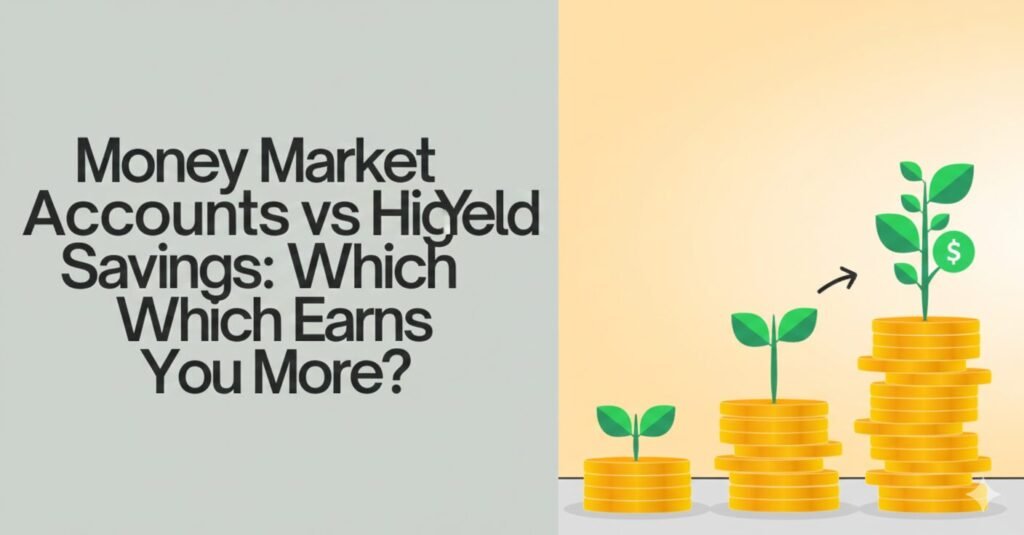
Both money market accounts and high-yield savings accounts currently offer 3% to 5% APY—10 times the national average—but money market accounts give you check-writing and debit card access while high-yield savings accounts often pay slightly higher rates.
Quick Facts: Money Market vs High-Yield Savings
| Feature | Money Market Account | High-Yield Savings Account |
|---|---|---|
| Typical APY Range | 3.50% to 4.50% | 3.80% to 5.00% |
| Check-Writing | Yes (usually limited) | No |
| Debit Card Access | Yes | Rarely |
| Minimum Opening Deposit | $500 to $10,000 | $0 to $500 |
| Monthly Fees | $10-$25 (often waived) | Usually $0 |
| Minimum Balance Required | $1,000 to $10,000 | $0 to $100 |
| FDIC Insurance | Yes ($250,000) | Yes ($250,000) |
| Best For | Active savers needing access | Passive savers maximizing growth |
Understanding Money Market Accounts
Money market accounts blend savings and checking account features. You earn competitive interest rates while maintaining direct access to your funds through checks and debit cards.
Banks structure these accounts as savings vehicles with added transaction capabilities. Your money stays in a deposit account earning interest, but you can write checks or use an ATM card when needed. This makes them more flexible than traditional savings accounts.
The interest rates compete with high-yield savings accounts. Current money market rates range from 3.50% to 4.50% APY depending on your balance and the financial institution. These rates fluctuate based on Federal Reserve policy and market conditions.
Most money market accounts use tiered interest structures. Higher balances earn better rates. For example, balances under $10,000 might earn 3.50% while balances above $25,000 earn 4.25%. This encourages you to maintain larger deposits.
Understanding High-Yield Savings Accounts
High-yield savings accounts function like regular savings accounts but pay significantly more interest. Online banks primarily offer these accounts because they operate with lower overhead costs than traditional banks.
Your deposits earn interest at rates currently ranging from 3.80% to 5.00% APY. These accounts helped savings grow from the national average of 0.40% to rates that actually keep pace with or exceed inflation in recent years.
The accounts work simply—deposit money, earn interest compounded daily, and watch your balance grow. You can’t write checks or use debit cards with most high-yield savings accounts. Instead, you transfer funds electronically to your checking account when you need cash.
This limited access actually helps many people save more. The extra step required to access funds prevents impulse spending. Your emergency fund or goal-based savings stays protected from casual withdrawals.
Interest Rates and APY Comparison
Money market accounts and high-yield savings accounts both offer strong returns compared to traditional savings products.
Current Rate Environment
High-yield savings accounts typically edge out money market accounts by 0.25% to 0.50% APY. The highest high-yield savings accounts currently pay around 5.00% while top money market accounts offer 4.00% to 4.50%.
This difference stems from account structure and banking costs. Online banks offering high-yield savings operate with minimal overhead, passing those savings to customers through higher rates. Money market accounts include additional features like check-writing and debit cards, which cost banks more to maintain.
The gap narrows with larger balances. Money market accounts with tiered rates may match or exceed high-yield savings rates once your balance crosses certain thresholds—often $25,000 to $50,000.
Rate Calculation Examples
On a $10,000 balance, the rate difference creates modest annual earnings gaps:
- 4.00% APY (money market): $408 per year
- 4.50% APY (high-yield savings): $459 per year
- Difference: $51 annually
On a $50,000 balance, the gap widens:
- 4.00% APY: $2,040 per year
- 4.50% APY: $2,295 per year
- Difference: $255 annually
These calculations assume daily compounding with monthly interest credits—the standard for both account types.
People also love to read this: Business Line of Credit vs Business Term Loan
Access and Liquidity Differences
The primary distinction between these accounts lies in how you access your money.
Money Market Account Access
Money market accounts provide multiple withdrawal methods. You receive checks that draw directly from your account. Many institutions issue debit cards linked to the account for ATM withdrawals and point-of-sale purchases.
This direct access makes money market accounts function almost like checking accounts. You can pay bills by check, withdraw cash at ATMs, or make purchases with your debit card—all while earning competitive interest rates.
However, federal regulations classify money market accounts as savings products. Banks may limit certain transaction types to six per month. Excessive withdrawals can trigger fees of $10 to $35 per transaction beyond the limit.
High-Yield Savings Account Access
High-yield savings accounts require indirect access to your funds. You initiate electronic transfers from your savings account to a checking account at the same bank or a different institution. These transfers typically take 1 to 3 business days to complete.
Some high-yield savings accounts include ATM cards, though this feature is less common. When provided, ATM access may come with monthly withdrawal limits of 6 to 9 transactions.
The delayed access serves a purpose beyond compliance. It creates a psychological barrier that helps you avoid dipping into savings for non-emergencies. Your money remains available but requires planning to access.
Fees and Minimum Requirements
Cost structures differ significantly between money market and high-yield savings accounts.
Money Market Account Costs
Money market accounts typically require substantial minimum opening deposits. Expect requirements ranging from $500 to $10,000, with $2,500 being common among traditional banks.
Monthly maintenance fees of $10 to $25 apply to many money market accounts. Banks waive these fees if you maintain minimum daily balances—usually $1,000 to $10,000. Fall below the threshold and you’ll pay the monthly fee, which can erase several months of interest earnings.
Excessive transaction fees add another cost layer. Each withdrawal or transfer beyond your monthly limit costs $10 to $35. Three extra transactions could cost you $30 to $105.
These requirements favor savers with larger balances who can comfortably meet minimums and avoid fees. If you’re building savings from scratch, the high barriers make money market accounts challenging.
High-Yield Savings Account Costs
Most high-yield savings accounts require $0 to $100 to open. Many banks let you start with a single dollar or nothing at all. This accessibility helps new savers get started immediately.
Monthly maintenance fees are rare with high-yield savings accounts. Online banks operate lean business models and pass those cost advantages to customers. You’ll find that 90% of high-yield savings accounts charge zero monthly fees regardless of your balance.
Minimum balance requirements typically don’t exist or stay low—$0 to $100 in most cases. You won’t face penalties for small balances, though you’ll earn less interest than someone with a larger deposit.
Who Benefits Most from Money Market Accounts
Money market accounts work best for specific financial situations and saving styles.
Active Savers
If you regularly deposit and occasionally withdraw from savings, money market accounts suit your needs. The check-writing and debit card features let you access funds immediately when opportunities or emergencies arise.
Business owners often prefer money market accounts for operating reserves. You can pay vendors by check while earning interest on your cash buffer. The direct access helps you manage cash flow without constant transfers between accounts.
Large Balance Holders
Savers with $25,000 or more benefit from tiered money market rates. At these balances, you often earn comparable or better rates than high-yield savings accounts while maintaining superior access.
Meeting minimum balance requirements becomes easy with substantial savings. A $10,000 minimum feels manageable when you’re maintaining $50,000 in the account. You avoid monthly fees effortlessly.
Simplified Banking Needs
If you want your savings and checking features in one account, money market accounts deliver. You reduce the number of accounts you manage while still earning competitive interest.
Some banks offer relationship bonuses when you bundle money market accounts with checking or other products. These perks can offset any rate disadvantages compared to high-yield savings accounts.
Who Benefits Most from High-Yield Savings Accounts
High-yield savings accounts serve different savings goals and financial situations.
Beginning Savers
If you’re building savings from $0 or a small amount, high-yield savings accounts remove barriers. You can open accounts with no minimum deposit and start earning 4% to 5% APY immediately on every dollar.
The lack of monthly fees means small balances grow without being eaten by maintenance charges. Even $100 earns $4 to $5 annually, all of which stays in your account.
Emergency Fund Builders
Emergency funds should be accessible but not too easy to tap for non-emergencies. High-yield savings accounts strike this balance perfectly. Your money remains available within 1 to 2 days but requires intentional action to withdraw.
The higher interest rates compared to checking accounts mean your emergency fund grows while sitting idle. On a $15,000 emergency fund earning 4.50%, you generate $675 annually versus $60 in a traditional savings account.
Goal-Based Savers
When saving for specific purchases—vacations, home down payments, weddings—high-yield savings accounts maximize your progress. Every dollar earns maximum interest while remaining liquid.
You can open multiple high-yield savings accounts at different banks to organize various goals. One account for your vacation fund, another for your home down payment, and a third for your car replacement fund. The segmentation helps you track progress without sacrificing returns.
Detailed Feature Comparison
| Feature | Money Market Account | High-Yield Savings Account |
|---|---|---|
| Average APY | 3.75% to 4.25% | 4.00% to 5.00% |
| Interest Compounding | Daily | Daily |
| Check Writing | Yes (limited transactions) | No |
| Debit Card | Usually included | Rarely included |
| ATM Access | Yes | Limited or none |
| Online Transfers | Yes | Yes |
| Mobile App | Yes | Yes |
| Typical Opening Minimum | $1,000 to $10,000 | $0 to $100 |
| Monthly Maintenance Fee | $10 to $25 | Usually $0 |
| Minimum Balance to Avoid Fees | $1,000 to $10,000 | None |
| Transaction Limits | 6 per month (certain types) | 6 per month (some banks) |
| FDIC Insurance Limit | $250,000 per depositor | $250,000 per depositor |
| Best Rate Tier | Often requires $25,000+ | All balances usually same rate |
| Overdraft Protection | Sometimes available | Rarely available |
FDIC Insurance Protection
Both account types carry identical FDIC insurance coverage. Your deposits receive protection up to $250,000 per depositor, per bank, per ownership category.
This federal guarantee means your money is safe even if your bank fails. The FDIC has never lost a penny of insured deposits since its creation in 1933. Whether you choose a money market account or high-yield savings account, your principal and accrued interest stay protected.
Increase coverage by using multiple banks. If you have $400,000 to save, split it between two banks to keep each deposit under $250,000. You can also use different ownership categories—individual, joint, retirement accounts—at the same bank to multiply your coverage.
Credit unions offer equivalent protection through NCUA insurance. The coverage limits and guarantees mirror FDIC insurance exactly. Whether you bank with a credit union or bank, your deposits receive the same federal backing.
Tax Implications
Interest earnings from both account types count as ordinary taxable income. Your bank reports interest to the IRS using Form 1099-INT if you earn more than $10 annually.
You’ll pay taxes at your marginal income tax rate, not the lower capital gains rate. If you’re in the 22% federal tax bracket and earn $500 in interest, you owe approximately $110 in federal taxes plus any state income taxes.
Calculate your after-tax return to understand true earnings. A 4.50% APY becomes 3.51% after-tax for someone in the 22% bracket. This still beats inflation and traditional savings accounts significantly.
Consider tax-advantaged alternatives for longer-term savings. Roth IRAs offer tax-free growth for retirement savings. Health savings accounts provide triple tax benefits for medical expenses. Use money market and high-yield savings accounts for short-term goals and emergency funds where liquidity matters more than tax efficiency.
When Money Market Accounts Win
Choose a money market account when:
- You maintain balances above $10,000 and can easily meet minimum requirements
- You need occasional check-writing capabilities for large expenses
- You want immediate ATM access to your savings
- You value having multiple access methods for your funds
- Your bank offers competitive rates on higher balance tiers
- You’re comfortable with the account structure and fees
Money market accounts work particularly well for business operating reserves, rental property reserves, and large emergency funds where you might need to write checks for major repairs or expenses.
People also love to read this: Equipment Financing and Section 179 Tax Deduction
When High-Yield Savings Accounts Win
Choose a high-yield savings account when:
- You’re starting with less than $5,000 in savings
- You want to avoid all monthly maintenance fees
- You prioritize the absolute highest interest rate available
- You don’t need check-writing or debit card access
- You want to open multiple accounts for different savings goals
- You prefer the simplicity of online-only banking
High-yield savings accounts excel for emergency funds, short-term savings goals, and situations where you want to maximize interest earnings without worrying about minimum balances or fees.
Combining Both Account Types
You don’t need to choose just one account type. Many successful savers use both strategically.
Strategic Allocation
Keep your emergency fund in a high-yield savings account where it earns maximum interest. You access it rarely, so the lack of immediate access isn’t a problem. The higher APY means your emergency fund grows faster.
Maintain short-term operating reserves in a money market account. This covers planned large expenses like insurance premiums, property taxes, or annual subscriptions. The check-writing feature makes paying these expenses convenient.
This two-account strategy gives you maximum returns on rarely-touched money while maintaining convenient access to funds you’ll use within the next few months.
Multi-Bank Approach
Open high-yield savings accounts at multiple online banks to maximize FDIC coverage and take advantage of the best rates. If Bank A offers 5.00% and Bank B offers 4.75%, use Bank A.
Maintain a money market account at your primary bank where you have checking. This keeps your main banking relationship intact while you chase higher rates elsewhere for long-term savings.
Rate Shopping and Switching
Interest rates change frequently. Banks adjust APYs based on Federal Reserve policy and competitive pressures.
Monitoring Your Rates
Check your current APY quarterly. Banks can reduce rates without notice. Your 4.50% account might drop to 3.75% while competitors maintain 4.25%.
Use rate comparison websites to track current offers. Bankrate, NerdWallet, and bank websites publish updated rates daily. Compare your current rate to the best available rates every three months.
When to Switch
Consider switching banks when:
- Your current rate falls 0.50% or more below competitors
- Your bank adds new fees or increases minimum requirements
- You find a bank offering better features at similar rates
- Promotional rates expire and your ongoing rate is poor
Switching costs you time but nothing financially. Electronic transfers move your money for free. Most banks don’t charge for closing accounts, though some require written requests.
Rate Stability Considerations
Online banks typically maintain more consistent rates. They adjust rates gradually rather than making dramatic cuts. Traditional banks often slash rates quickly when the Federal Reserve cuts its benchmark rate.
Look for banks with histories of competitive rates over multiple years. A bank consistently in the top 10% for rates will likely remain competitive even as the overall rate environment changes.
Alternative Savings Options
Beyond money market and high-yield savings accounts, consider these alternatives for different scenarios.
Certificates of Deposit (CDs)
CDs offer guaranteed rates for specific terms—3 months to 5 years. Current rates range from 4.00% to 5.00% depending on term length. Your money locks in for the full term.
Use CDs for savings you absolutely won’t need to access. The early withdrawal penalty (typically 3 to 12 months of interest) makes CDs unsuitable for emergency funds but excellent for goal-based savings with fixed timelines.
Money Market Mutual Funds
Don’t confuse money market accounts with money market mutual funds. Money market funds are investment products, not bank accounts. They’re not FDIC-insured, though they’re considered very low risk.
Current money market fund yields range from 4.00% to 5.00%. They invest in short-term government and corporate debt. Use them for cash you’re comfortable investing rather than saving.
Checking Accounts
Some high-yield checking accounts pay competitive interest—2.00% to 3.00% APY. They require multiple monthly debit card transactions and direct deposits to earn the higher rates.
Consider these if you can meet activity requirements and want to consolidate savings and checking in one account.
Federal Reserve Impact
The Federal Reserve’s benchmark rate directly influences money market and high-yield savings rates. When the Fed raises rates, savings rates increase within weeks. When the Fed cuts rates, savings rates fall.
The Fed cut rates three times in late 2024, reducing its benchmark from 5.25-5.50% to 4.25-4.50%. Savings rates dropped from peaks above 5.50% to current ranges of 3.80% to 5.00%.
More rate cuts may happen throughout the coming months. Each 0.25% Fed cut typically reduces savings rates by a similar amount. Your 4.50% account might become 4.00% or 3.75% as the Fed continues its cutting cycle.
Despite expected decreases, current rates remain historically attractive. The decade following the 2008 financial crisis saw savings rates below 1.00%. Today’s environment offers significantly better returns even as rates moderate from recent peaks.
Account Opening Process
Opening either account type takes 10 to 20 minutes online.
Required Information
Prepare these details before starting:
- Social Security number
- Driver’s license or state ID
- Proof of address (utility bill or bank statement)
- Employment information
- Funding account details (routing and account numbers)
Application Steps
- Choose Your Institution: Compare rates and features across multiple banks
- Complete the Application: Provide personal information and create login credentials
- Verify Your Identity: Answer knowledge-based questions about your credit history
- Fund the Account: Link an external bank account for electronic transfers
- Review Terms: Read disclosure documents before finalizing
- Confirm Opening: Receive confirmation email with account details
Initial deposits take 1 to 3 business days to process via electronic transfer. Some banks accept wire transfers for faster funding.
Managing Your Account
Setting Up Automatic Transfers
Schedule recurring transfers from checking to savings. Even $100 biweekly grows to $2,600 annually plus interest. Automation ensures consistent saving without requiring willpower.
Time transfers for right after payday. This “pay yourself first” approach prioritizes savings before other expenses tempt you.
Maximizing Interest Earnings
Keep your balance as high as comfortably possible. Every dollar earns interest from day one. A $15,000 balance at 4.50% generates $675 annually versus $338 on a $7,500 balance.
Make deposits promptly when you receive windfalls—tax refunds, bonuses, or monetary gifts. The sooner money enters your account, the more interest it generates.
Avoiding Common Mistakes
Don’t exceed transaction limits. Each excessive withdrawal costs $10 to $35 in fees. Plan your transfers to stay within limits.
Don’t ignore rate changes. Set calendar reminders to check your APY quarterly. Staying vigilant prevents you from missing better opportunities elsewhere.
Don’t keep unnecessary cash in checking. Move excess funds above 1 to 2 months of expenses into your high-yield account. That money earns 4% to 5% instead of 0.01%.
Can I lose money in a money market account or high-yield savings account?
No, you cannot lose your principal in either account type. Both are FDIC-insured deposit accounts that protect your balance up to $250,000 per depositor, per bank. Your money grows through interest—it never decreases. However, inflation can reduce your purchasing power even as your nominal balance increases. If inflation runs at 3% and you earn 4%, your real return is 1%. This is still better than losing purchasing power in a 0.40% traditional savings account.
How often do interest rates change on these accounts?
Interest rates are variable and can change at any time without notice. Banks typically adjust rates within days or weeks after Federal Reserve policy changes. During periods of frequent Fed rate adjustments, your APY might change monthly. During stable rate environments, banks may keep rates steady for several months. Check your current rate monthly by logging into your account. The rate appears on your statement and account dashboard. Banks must notify you of rate changes, but they often do so by simply updating the rate on their website.
Can I have both types of accounts at the same bank?
Yes, most banks allow you to open both a money market account and a high-yield savings account. Having both at the same institution simplifies transfers between accounts. You might use this strategy to keep emergency funds in high-yield savings (earning maximum interest) while maintaining a money market account for planned expenses (providing check-writing access). Some banks offer rate bonuses when you maintain multiple accounts. Check with your bank about relationship perks and whether having multiple accounts provides any benefits beyond account features.
Are money market accounts the same as money market funds?
No, they are completely different products. Money market accounts are FDIC-insured bank deposit accounts that earn interest. Money market funds are investment products offered through brokerages that invest in short-term debt securities. Money market accounts cannot lose principal and are guaranteed by the federal government up to $250,000. Money market funds can theoretically lose value, though this is extremely rare, and they’re not FDIC-insured. Money market funds may offer slightly higher yields but come with investment risk. Choose money market accounts for savings you want fully protected.
What happens if I need to withdraw more than my monthly limit?
Most banks charge excessive transaction fees of $10 to $35 for each withdrawal or transfer beyond your monthly limit—typically six transactions. After multiple violations, banks may convert your account to a checking account or close it entirely. If you anticipate needing frequent withdrawals, plan ahead by transferring a lump sum to checking that covers multiple expenses. Alternatively, use ATM withdrawals (if available), which usually don’t count toward transaction limits. For accounts where you regularly exceed limits, consider switching to a checking account instead.