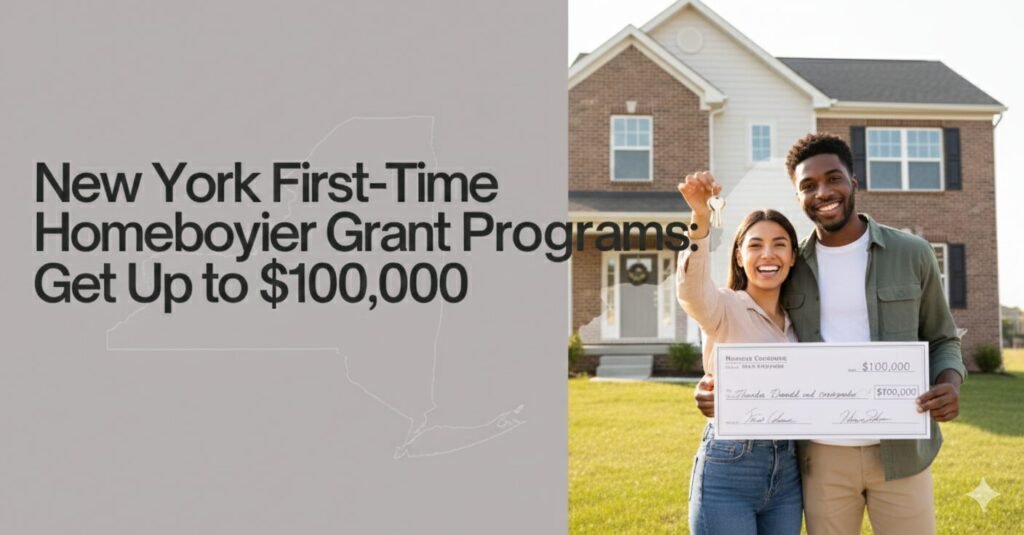
New York offers first-time homebuyers up to $100,000 in grants and down payment assistance through state and city programs, making homeownership possible even with limited savings.
Quick Facts About New York Homebuyer Programs
| Program Feature | Details |
|---|---|
| Maximum Grant Amount | Up to $100,000 (HomeFirst NYC) |
| Down Payment Assistance | $3,000 to $30,000 (SONYMA DPAL) |
| Income Requirements | Typically 80-120% of Area Median Income |
| Eligible Property Types | 1-4 family homes, condos, co-ops |
| First-Time Buyer Definition | No home ownership in past 3 years |
| Required Education | Homebuyer counseling course mandatory |
| Loan Forgiveness | 10-15 years depending on program |
Understanding New York’s First-Time Homebuyer Programs
New York provides first-time homebuyers multiple paths to homeownership through grants and low-interest loans. These programs reduce your upfront costs and monthly payments, putting homeownership within reach even if you don’t have a large down payment saved.
The state and city work together to offer assistance programs. SONYMA (State of New York Mortgage Agency) runs statewide programs, while NYC’s HomeFirst targets city residents. You can combine multiple programs to maximize your benefits.
HomeFirst Down Payment Assistance Program
HomeFirst gives qualified NYC first-time buyers up to $100,000 toward down payments or closing costs. This is a forgivable loan that disappears if you live in the home long enough.
Program Benefits
You receive up to 20% of your home’s purchase price, with a $100,000 cap. The money comes as a forgivable loan at 0% interest. After living in the home for the required occupancy period, the entire loan gets forgiven—you never repay it.
The city expanded the program in early 2025, adding $41 million in new funding and raising income limits to 120% of area median income. This means more families now qualify.
Eligibility Requirements
You must be a first-time homebuyer purchasing a 1-4 family home, condo, or co-op in NYC’s five boroughs. You need to complete a homebuyer education course through an HPD-approved counseling agency.
Your household income can’t exceed 120% of the area median income. You must contribute at least 3% of the purchase price from your own savings—the program won’t cover your entire down payment.
The home must pass a Housing Quality Standards inspection before you close. You’ll work with a mortgage lender whose loans are regulated by federal or state agencies.
Occupancy Requirements
You must live in the home as your primary residence. For loans under $40,000, you need 10 years of occupancy for full forgiveness. For loans over $40,000, the requirement extends to 15 years.
If you sell or move before meeting the occupancy period, you’ll repay a portion of the loan based on how long you lived there.
How to Apply
Contact an HPD-approved housing counseling agency to start your application. The counselor checks your eligibility and guides you through each step. You’ll complete your homebuyer education course with them.
After approval, you receive a commitment letter. You then find your home, make an offer, and complete the purchase with both your primary mortgage and the HomeFirst assistance.
SONYMA Down Payment Assistance Loan (DPAL)
SONYMA’s DPAL provides 0% interest loans to help cover down payments and closing costs. You can use DPAL with any SONYMA mortgage program.
Standard DPAL Benefits
The loan amount is the higher of $3,000 or 3% of your purchase price, up to $15,000 maximum. You make no monthly payments on this loan. After 10 years of living in your home, the entire DPAL gets forgiven.
If you sell or refinance before 10 years, you repay a portion based on how long you owned the home. The repayment amount decreases by 1/120th each month you live there.
DPAL Plus for Enhanced Assistance
DPAL Plus offers up to $30,000 for eligible low-income first-time buyers. You must earn at or below 80% of area median income. Veterans and buyers purchasing in federally designated target areas also qualify regardless of whether it’s their first home.
DPAL Plus forgives in equal monthly installments over 10 years. You must complete homebuyer education before loan approval.
Using DPAL
You can apply DPAL toward your down payment, closing costs, or upfront mortgage insurance. The assistance helps you meet SONYMA’s minimum cash contribution requirements—typically 1% for single-family homes and condos, or 3% for co-ops and multi-family properties.
Your SONYMA mortgage interest rate increases by 0.375% when you use standard DPAL. This rate adjustment doesn’t apply to DPAL Plus or certain special programs like Homes for Veterans.
People also love to read this: Disability and Income Protection Insurance
SONYMA Mortgage Programs
SONYMA offers two main mortgage programs with competitive rates and flexible terms for first-time buyers.
Achieving the Dream Program
This program delivers SONYMA’s lowest available interest rates. You get a 30-year fixed-rate mortgage with financing up to 97% of your home’s value.
You need just a 1% cash contribution for single-family homes, condos, and manufactured homes (3% for co-ops and 3-4 family homes). The program works for purchases of 1-4 family homes, condos, co-ops, and manufactured homes.
You can combine Achieving the Dream with DPAL or DPAL Plus for comprehensive assistance. Income and purchase price limits apply based on your county.
Low Interest Rate Program
This program offers competitive fixed rates with similar low down payment requirements. You finance up to 97% of the property value with the same cash contribution requirements as Achieving the Dream.
The interest rates run slightly higher than Achieving the Dream but remain competitive with conventional mortgages. You get 240-day rate locks for new construction or co-op purchases at no cost.
FHA Plus and Conventional Plus
SONYMA combines 30-year fixed-rate mortgages with automatic down payment assistance through these programs. Both first-time buyers and previous homeowners qualify.
The down payment assistance covers closing costs and can eliminate monthly mortgage insurance by paying the upfront premium. These programs offer flexible underwriting guidelines and lower monthly payments than standard mortgages.
Income limits apply—you must earn less than 80% of area median income for Conventional Plus. FHA Plus follows standard FHA income guidelines.
Special SONYMA Programs
Homes for Veterans
Veterans, active military, National Guard members, and reservists get SONYMA’s lowest rates plus up to $15,000 in down payment assistance. You need just a 1% cash contribution.
The program doesn’t require first-time buyer status for veterans. You can use it regardless of your previous homeownership history. Financing for home improvements can be included in your loan.
Graduate to Homeownership
Recent college graduates who finished within the past 48 months qualify for special assistance. You must have an associate, bachelor’s, master’s, or doctoral degree from a U.S. Department of Education-recognized program.
You get low-interest financing and can combine the program with down payment assistance. Regional income limits apply based on your county.
RemodelNY Program
This program lets you buy a fixer-upper and finance eligible repairs into your mortgage. You can combine RemodelNY with other SONYMA programs including Achieving the Dream and Homes for Veterans.
The financing covers both purchase price and renovation costs in a single loan. You work with approved contractors to complete the repairs after closing.
Federal Home Loan Bank Programs
The Federal Home Loan Bank of New York administers additional grant programs through participating member banks.
Homebuyer Dream Program (HDP)
HDP provides up to $30,000 in grants for down payment, closing costs, and homebuyer counseling. You must earn at or below 80% of area median income and work with a participating lender.
The program targets first-time homebuyers but includes veterans and buyers in designated areas regardless of homeownership history.
HDP Plus
This program serves households earning 80-120% of area median income. You receive up to $30,000 in grant assistance through participating member institutions.
You can layer HDP Plus with standard HDP for combined assistance up to $60,000 per household.
HDP Wealth Builder
Designed to address historical disparities in homeownership, this program provides grants to individuals who have faced challenges accessing credit or housing markets. You can receive up to $30,000 and layer it with other HDP programs for $60,000 total assistance.
County and Local Programs
Nassau County First-Time Homebuyer Program
Nassau County offers down payment assistance to eligible first-time buyers. The program provides loans to cover down payment and closing costs for homes in Nassau County.
Income limits and purchase price restrictions apply. Contact the Nassau County Office of Housing and Community Development for current program details.
Housing Opportunities Foundation
This program provides $2,000 grants through the New York State Association of Realtors and Community Foundation. While smaller than other programs, it stacks with state assistance.
First-time buyers in participating areas can apply through their real estate agent.
NeighborhoodLIFT
NeighborhoodLIFT offers up to $20,000 in assistance for properties in Brooklyn, Bronx, or Queens. The program provides five-year forgivable loans—a portion forgives each year you live in the home.
All buyers qualify, not just first-time buyers. If you move before five years, you repay the remaining balance immediately.
Eligibility Requirements Across Programs
Most New York homebuyer programs share common eligibility criteria.
First-Time Buyer Definition
You qualify as a first-time buyer if you haven’t owned a home in the past three years. This includes people who owned homes longer ago and single parents who only owned with a spouse.
Displaced homemakers who only owned with a spouse also meet the definition. Some programs waive this requirement for veterans purchasing in designated areas.
Income Limits
Programs set income limits as percentages of area median income (AMI). Limits vary by program, household size, and location:
- Standard programs: 80% AMI or less
- Expanded programs: Up to 120% AMI
- DPAL Plus: 80% AMI or less
- Federal programs: Varies by specific program rules
Check current limits for your county and household size on program websites.
Credit and Employment Requirements
You need stable employment history—typically two years of continuous, verifiable income. Most programs require decent credit, though SONYMA offers flexible underwriting through its Credit is Due program.
You must show sufficient income to handle mortgage payments, other debts, and living expenses. Lenders calculate your debt-to-income ratio to verify affordability.
Property Requirements
Eligible properties include 1-4 family homes, condominiums, cooperatives, and manufactured homes permanently affixed to foundations. The home must meet program-specific requirements and pass inspections.
You must occupy the property as your primary residence. Investment properties and vacation homes don’t qualify.
Homebuyer Education
Nearly all programs require completion of a homebuyer education course. HUD-approved counseling agencies offer these courses online, in person, or through workshops.
The courses cover budgeting, credit management, the home-buying process, and preventing foreclosure. You receive a certificate upon completion that you’ll need for your application.
People also love to read this: Long-Term Disability Insurance for High-Income Professionals
Combining Multiple Programs
You can stack several assistance programs to maximize your benefits. The key is understanding which programs work together.
Layering Strategies
Start with a SONYMA mortgage (Achieving the Dream or Low Interest Rate). Add DPAL or DPAL Plus for down payment assistance. If you qualify for HomeFirst and live in NYC, combine it with your SONYMA loan for substantial assistance.
Veterans should use Homes for Veterans as their base program. Recent graduates can combine Graduate to Homeownership with DPAL. Always check with your lender about specific program compatibility.
Example Scenarios
A first-time buyer in Brooklyn earning 75% AMI could combine:
- SONYMA Achieving the Dream mortgage (lowest rates)
- DPAL Plus ($30,000 down payment assistance)
- HomeFirst ($100,000 additional assistance)
- Total potential assistance: $130,000
A veteran in Buffalo could use:
- SONYMA Homes for Veterans (lowest rates, no first-time requirement)
- DPAL ($15,000 standard assistance)
- Total potential assistance: $15,000 plus preferred rates
Application Process
Follow these steps to apply for New York homebuyer programs.
Step 1: Take Homebuyer Education
Enroll in and complete a HUD-approved homebuyer education course. Find courses through housing counseling agencies across New York. Most courses take 6-8 hours and cost $50-$125.
Save your completion certificate—you’ll need it for all program applications.
Step 2: Get Pre-Approved
Contact a SONYMA-participating lender or lender offering your chosen programs. Submit financial documents including tax returns, pay stubs, bank statements, and proof of employment.
The lender reviews your finances and determines how much you can borrow. You receive a pre-approval letter showing sellers you’re a serious buyer.
Step 3: Apply for Assistance Programs
Work with your housing counselor to apply for grants and assistance programs. Submit required documentation including your homebuyer education certificate, income verification, and identification.
For HomeFirst, contact an HPD-approved counseling agency. For SONYMA programs, work directly with your participating lender.
Step 4: Shop for Homes
Search for homes within program price limits in eligible areas. Your real estate agent should understand program requirements and help find qualifying properties.
Make offers on homes that meet program standards. Your pre-approval and assistance commitments strengthen your offers.
Step 5: Complete Your Purchase
Schedule home inspections and appraisals. Your lender coordinates the VA or SONYMA appraisal required by your loan program.
Review and sign closing documents. Your grants and assistance loans fund at closing along with your primary mortgage.
Move into your new home and meet occupancy requirements to earn loan forgiveness.
Program Comparison
| Program | Maximum Assistance | Income Limit | Forgiveness Period | Eligible Areas |
|---|---|---|---|---|
| HomeFirst | $100,000 | 120% AMI | 10-15 years | NYC only |
| SONYMA DPAL | $15,000 | Varies | 10 years | Statewide |
| SONYMA DPAL Plus | $30,000 | 80% AMI | 10 years | Statewide |
| FHLB HDP | $30,000 | 80% AMI | Varies | NY/NJ/PR/VI |
| FHLB HDP Plus | $30,000 | 120% AMI | Varies | NY/NJ/PR/VI |
| NeighborhoodLIFT | $20,000 | Varies | 5 years | Brooklyn, Bronx, Queens |
Tips for Maximizing Your Benefits
Start your homebuying journey by attending a homebuyer education course early. The earlier you complete it, the sooner you can apply for programs.
Work with experienced housing counselors who know program requirements and application processes. They identify which programs you qualify for and help you combine multiple assistance sources.
Build your savings even though programs offer down payment help. You’ll need your own funds for earnest money deposits and part of your down payment. Having reserves also strengthens your application.
Improve your credit score before applying. Higher scores qualify you for better interest rates, saving thousands over your loan’s life. Pay bills on time, reduce credit card balances, and avoid opening new credit accounts.
Get pre-approved before house hunting. Pre-approval shows sellers you’re serious and can close the deal. It also reveals any application issues you can fix before finding your dream home.
Compare multiple lenders offering SONYMA programs. Interest rates and fees vary between participating lenders. Shopping around saves money.
Ask about rate locks when applying. SONYMA offers extended rate locks for new construction at no cost. Lock your rate when you find favorable terms.
Common Program Restrictions
Understanding program restrictions helps you avoid application problems.
Purchase Price Limits
SONYMA sets maximum purchase prices by county and property type. Limits reflect local housing costs. Check current limits on SONYMA’s website before house hunting.
NYC’s HomeFirst doesn’t specify purchase price limits but caps assistance at 20% of the price or $100,000.
Cash Contribution Requirements
Even with full assistance, you must contribute your own money toward the purchase. SONYMA requires 1% for most single-family homes and condos, 3% for co-ops and multi-family properties.
This money can’t come from gifts in most cases—you must show it as savings. Plan to have this amount in your bank account for at least two months before applying.
Refinancing Restrictions
If you refinance your mortgage before meeting the forgiveness period, you must repay assistance loans. Some programs allow refinancing into another program loan without repayment.
Always check with your servicer before refinancing to understand repayment requirements.
Occupancy and Selling
You must live in the home as your primary residence throughout the forgiveness period. Renting it out or using it as a second home violates program terms.
If you sell before meeting occupancy requirements, you repay part or all of assistance loans based on time lived in the home.
Finding Help and Resources
Multiple organizations help first-time buyers navigate New York’s programs.
Housing Counseling Agencies
HUD-approved counseling agencies provide free or low-cost services including homebuyer education, application assistance, and foreclosure prevention counseling. Find agencies through HUD’s website or by calling SONYMA.
These agencies know local programs and can identify assistance you might miss on your own.
SONYMA Resources
Visit hcr.ny.gov/sonyma for program details, rate information, and lender lists. Call 1-800-382-4663 to speak with SONYMA staff about your situation.
SONYMA hosts bi-monthly information calls and in-person events. Attend these sessions to learn directly from program administrators and ask questions.
NYC HPD Resources
For HomeFirst questions, contact the NYC Department of Housing Preservation and Development. Visit their website at nyc.gov/hpd or call HPD-approved counseling agencies.
Participating Lenders
Work with lenders who regularly process SONYMA and HomeFirst applications. Experienced lenders understand program requirements and can expedite approvals.
Not all lenders offer all programs. Confirm program availability when selecting your lender.
Understanding Program Changes
First-time homebuyer programs evolve based on funding availability and policy priorities.
Recent changes include expanding HomeFirst income limits to 120% AMI and doubling the program’s funding. SONYMA periodically adjusts purchase price limits and assistance amounts based on housing market conditions.
Check program websites for current details before applying. What you read in older articles might not reflect current terms.
Tax Implications
Assistance programs can affect your taxes. Mortgage interest remains deductible on your federal and state returns. Assistance loans that get forgiven aren’t typically taxable income because forgiveness depends on living in your home.
Consult a tax professional about your specific situation. Rules can change, and individual circumstances vary.
Avoiding Common Mistakes
Don’t apply for programs you don’t qualify for. Read eligibility requirements carefully before starting applications. Applying for programs you can’t use wastes time and delays your home purchase.
Don’t assume you can’t afford homeownership without checking programs. Many people qualify for assistance they don’t know exists.
Don’t skip homebuyer education. Counselors provide valuable information that helps you succeed as a homeowner. The course requirement exists because educated buyers are more successful.
Don’t work with unlicensed lenders or counselors. Stick with HUD-approved agencies and SONYMA-participating lenders. Scammers target homebuyers with promises of guaranteed approvals or special deals.
Don’t forget about occupancy requirements. These aren’t suggestions—they’re binding loan terms. Violating them means repaying assistance you thought was forgiven.
What happens if I lose my job after buying a home?
Contact your lender immediately if you experience income loss or financial hardship. Many programs offer forbearance or loan modification options during temporary setbacks. SONYMA works with borrowers facing difficulties to help them keep their homes. The sooner you reach out, the more options you’ll have to resolve the situation.
Can I rent out rooms while meeting occupancy requirements?
You can rent out rooms or separate units in multi-family properties while living there as your primary residence. The property must remain your principal home. However, moving out completely and renting the entire property violates program terms and triggers loan repayment obligations.
Do assistance programs affect my credit score?
The assistance loans themselves don’t affect your credit differently than regular mortgages. Payment history on your primary mortgage impacts your score. DPAL and similar assistance loans typically don’t require monthly payments, so they don’t create payment history. Late payments on your primary mortgage will hurt your credit.
Can non-citizens apply for these programs?
Permanent residents with green cards qualify for most programs. Requirements vary by specific program, but legal residency is typically acceptable. DACA recipients and other non-permanent residents should check individual program eligibility. Some programs require U.S. citizenship, while others accept various legal resident statuses.
What if home prices exceed program limits?
If homes in your target area cost more than program purchase price limits, you’ll need to expand your search area, wait for limit increases, or consider conventional financing without program assistance. Price limits exist because programs aim to serve moderate-income buyers in affordable housing. Some areas with high costs have higher limits—check limits by county to find where you can use assistance.