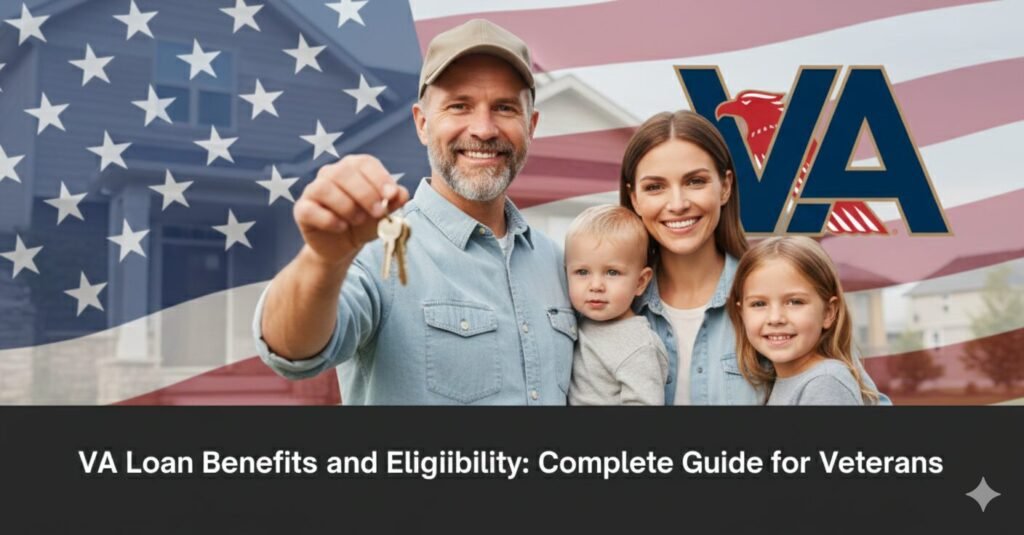
VA loans help veterans, active-duty service members, and eligible surviving spouses buy homes with zero down payment, no private mortgage insurance, and competitive interest rates.
Quick Facts About VA Loans
| Feature | Details |
|---|---|
| Down Payment | $0 required (with full entitlement) |
| Private Mortgage Insurance (PMI) | Not required |
| Loan Type | Government-backed mortgage |
| Eligible Borrowers | Veterans, active-duty military, National Guard, Reserves, surviving spouses |
| Funding Fee | 1.25% to 3.3% (waived for disabled veterans) |
| Reusability | Can be used multiple times |
| Credit Score | No VA minimum (lenders typically require 580+) |
Understanding VA Loan Benefits
VA loans give you access to homeownership advantages that aren’t available with conventional mortgages.
Zero Down Payment
You can buy a home without paying anything upfront. About 74% of first-time VA loan users put zero down on their home purchase. This means you can keep your savings for home improvements, emergency funds, or other investments instead of spending years accumulating a down payment.
No Private Mortgage Insurance
Conventional loans typically require PMI when you put down less than 20%. VA loans don’t have this requirement, saving you hundreds of dollars every month. On a $250,000 loan, avoiding PMI could save you $150-$200 monthly.
Competitive Interest Rates
VA mortgage rates consistently rank among the lowest in the market. Lower rates mean you qualify for more house and pay less over the life of your loan.
Limited Closing Costs
The VA caps the fees lenders can charge, keeping your out-of-pocket expenses manageable. Sellers can pay up to 4% of the loan amount toward your closing costs.
Reusable Benefit
You can use your VA loan benefit multiple times throughout your life. Once you sell or pay off a previous VA-backed home, you can restore your entitlement and use it again.
People also love to read this: Earthquake Insurance Cost-Benefit Analysis by State
VA Loan Eligibility Requirements for Veterans
Your military service determines your VA loan eligibility. The requirements vary based on when and how long you served.
Active-Duty Service Members
You qualify after serving at least 90 continuous days on active duty.
Veterans
You meet the requirements if you served:
- 24 continuous months during peacetime
- 90 days during wartime
- 181 days of continuous active duty during peacetime
- Any length of service if discharged for a service-connected disability
National Guard and Reserve Members
You become eligible after:
- 6 years of service in the Selected Reserve or National Guard
- 90 days of active-duty service (including at least 30 consecutive days under Title 32)
Surviving Spouses
You may qualify if you’re:
- The unmarried surviving spouse of a veteran who died from service-connected causes
- The surviving spouse of a service member who died on active duty
- The spouse of a service member missing in action (MIA) or prisoner of war (POW) for over 90 days
- A surviving spouse who remarried after age 57 (on or after December 16, 2003)
Discharge Requirements
Your discharge status affects your eligibility. Acceptable discharges include:
- Honorable discharge
- General discharge under honorable conditions
- Entry-level separation
Discharges that are Other Than Honorable, Bad Conduct, or Dishonorable typically make you ineligible. You can apply for a discharge upgrade to potentially qualify.
How to Get Your Certificate of Eligibility (COE)
The COE proves to lenders that you meet VA loan requirements. You can obtain it through three methods:
Online Application
Apply through the VA’s eBenefits portal or VA.gov. This is the fastest method, often providing instant results.
Through Your Lender
Many VA-approved lenders can request your COE directly during the loan application process.
By Mail
Submit VA Form 26-1880 with your discharge papers (DD214) to your regional VA loan center.
VA Loan Entitlement Explained
Your entitlement is the amount the VA guarantees on your loan. Understanding it helps you know how much you can borrow.
Basic Entitlement
You have $36,000 in basic entitlement. This covers loans up to $144,000.
Bonus Entitlement
For loans over $144,000, bonus entitlement covers 25% of your county’s loan limit. With full entitlement, you can borrow as much as you qualify for without a down payment.
Partial Entitlement
If you have an existing VA loan or previously defaulted, you have partial entitlement. You might need a down payment depending on your remaining entitlement and the loan amount.
VA Loan Funding Fee
The funding fee helps offset program costs for taxpayers. It ranges from 1.25% to 3.3% of your loan amount based on:
- Whether it’s your first VA loan or a subsequent use
- Your down payment amount (if any)
- Your military category (regular military, Reserves, National Guard)
You can pay the fee upfront or roll it into your mortgage.
Funding Fee Exemptions
You don’t pay the funding fee if you:
- Receive VA disability compensation
- Are eligible for disability compensation but receive retirement pay instead
- Are a surviving spouse receiving Dependency and Indemnity Compensation (DIC)
For a $250,000 loan, the first-time funding fee is $5,375 (2.15%). Disabled veterans save this entire amount.
People also love to read this: Landlord Insurance vs Homeowners Insurance
Types of VA Loans Available
The VA offers several loan programs for different homeownership needs.
Purchase Loans
Buy a home, condo, manufactured home, or multi-unit property (up to 4 units) with no down payment.
Interest Rate Reduction Refinance Loan (IRRRL)
Lower your interest rate and monthly payment on an existing VA loan. This streamlined refinance doesn’t require a new appraisal or credit underwriting in many cases.
Cash-Out Refinance
Tap into your home equity for debt consolidation, home improvements, or other expenses. You can refinance a non-VA loan into a VA loan through this program.
Native American Direct Loan (NADL)
Native American veterans can buy, build, or improve homes on federal trust land through this direct loan program. Your tribal organization must participate.
Adapted Housing Grants
Veterans with certain service-connected disabilities can receive grants to build or modify homes for accessibility:
- Specially Adapted Housing (SAH): Up to $121,812 (fiscal year data)
- Special Home Adaptation (SHA): Up to $24,405 (fiscal year data)
Property Requirements and Appraisal
The property you buy must meet VA minimum property requirements and serve as your primary residence.
VA Appraisal
Every VA purchase requires a VA appraisal to:
- Determine fair market value
- Ensure the property meets VA minimum standards
- Protect you from overpaying
The appraisal includes health and safety inspections. If issues arise, sellers must make repairs before closing or you can negotiate who handles them.
Occupancy Requirements
You must intend to occupy the home as your primary residence. Active-duty service members can have a spouse or dependent occupy the property if they’re stationed elsewhere.
Credit and Income Requirements
The VA doesn’t set minimum credit scores, but most lenders require:
- Credit score of 580 or higher
- Stable income sufficient to cover monthly payments
- Acceptable debt-to-income ratio (typically 41% or less)
- Adequate residual income (money left after paying monthly debts)
Residual Income
The VA uses residual income requirements to ensure you can afford your mortgage and still have enough for food, utilities, and other necessities. Required amounts vary by region, family size, and loan amount.
Down Payment Scenarios
While most VA buyers purchase with zero down, you might need a down payment if:
- The purchase price exceeds the appraisal value
- You have partial entitlement and are borrowing above your remaining guarantee
- You’re buying with a non-eligible co-borrower
You can choose to make a down payment to reduce your funding fee and monthly payments, even if it’s not required.
Special Benefits for Disabled Veterans
Veterans with service-connected disabilities receive additional advantages beyond the funding fee exemption.
Property Tax Exemptions
Many states offer property tax reductions for disabled veterans. These vary by state and disability rating.
Energy-Efficient Mortgages
You can finance up to $6,000 in energy-efficient improvements into your loan without increasing your down payment.
Adapted Housing Grants
If you have certain permanent and total disabilities, grants help you purchase or modify a home with accessibility features like wheelchair ramps, widened doorways, or roll-in showers.
Closing Costs and Seller Concessions
VA loans limit allowable closing costs and let sellers contribute to your expenses.
Allowed Closing Costs
You can pay:
- VA funding fee
- Appraisal
- Credit report
- Title insurance
- Recording fees
- Origination fee (up to 1% of loan amount)
- Discount points
Non-Allowed Closing Costs
The VA prohibits lenders from charging you for:
- Attorney fees
- Commission or brokerage fees
- Photos
Seller Concessions
Sellers can pay up to 4% of the loan amount toward:
- Prepaid closing costs
- Funding fee
- Payoff of credit balances or judgments
- Temporary interest rate buydowns
Comparing VA Loans to Other Loan Types
| Feature | VA Loan | FHA Loan | Conventional Loan |
|---|---|---|---|
| Down Payment | 0% | 3.5% minimum | 3-20% |
| Mortgage Insurance | None (funding fee instead) | Required (MIP) | Required if down < 20% (PMI) |
| Credit Score | 580+ (lender requirement) | 580+ | 620+ |
| Interest Rates | Competitive | Moderate | Varies by down payment |
| Occupancy | Primary residence | Primary residence | Primary or investment |
| Reusability | Unlimited | Unlimited | Unlimited |
Common VA Loan Myths Debunked
Myth: VA Loans Take Longer to Close
VA loans close in similar timeframes as other loan types, typically 30-45 days.
Myth: Sellers Won’t Accept VA Offers
Many sellers welcome VA buyers because they’re pre-qualified and the VA appraisal provides additional property assurance.
Myth: You Can Only Use VA Loans Once
You can use your benefit multiple times throughout your life.
Myth: VA Loans Are Only for First-Time Buyers
Veterans can use VA loans whether it’s their first home or their fifth.
Steps to Get a VA Loan
- Check Your Eligibility: Review service requirements to confirm you qualify.
- Get Your COE: Apply online, through your lender, or by mail.
- Get Pre-Approved: Work with a VA-approved lender to determine your budget.
- Find a Property: Search for homes that meet VA property requirements.
- Make an Offer: Submit your purchase offer with your pre-approval letter.
- Complete the VA Appraisal: The lender orders an appraisal to verify property value and condition.
- Finalize Your Loan: Complete underwriting and prepare for closing.
- Close on Your Home: Sign final documents and receive your keys.
Tips for Maximizing Your VA Loan Benefits
- Shop Multiple Lenders: Rates and fees vary. Compare at least three lenders to find the best deal.
- Improve Your Credit Score: Higher scores can qualify you for better rates, potentially saving thousands over the loan term.
- Calculate Total Costs: Factor in funding fees, closing costs, and monthly payments when budgeting.
- Consider a Shorter Term: If you can afford higher monthly payments, a 15-year mortgage saves significantly on interest compared to 30 years.
- Make Extra Payments: Paying extra toward principal reduces interest and helps you build equity faster.
- Negotiate Seller Concessions: Ask sellers to contribute toward your closing costs to minimize out-of-pocket expenses.
- Restore Your Entitlement: If you’ve used your benefit before, restore your entitlement by selling and paying off your previous VA loan.
When You Might Need Help
Contact the VA at 1-877-827-3702 if you’re:
- Struggling to make payments
- Facing potential foreclosure
- Unsure about your eligibility
- Having trouble getting your COE
The VA offers counseling and support to help veterans avoid foreclosure and resolve loan issues.
Frequently Asked Questions
What credit score do I need for a VA loan?
The VA doesn’t require a minimum credit score, but most lenders want to see at least 580. Some lenders may approve borrowers with lower scores depending on other compensating factors like stable employment and low debt.
Can I use a VA loan to buy a second home or investment property?
No. VA loans are only for primary residences. You must intend to occupy the home within a reasonable time after closing, typically 60 days. However, you can buy a multi-unit property (up to 4 units), live in one unit, and rent the others.
How long does it take to get a Certificate of Eligibility?
If you apply online through VA.gov or eBenefits, you can often get your COE instantly. Applications by mail take longer, typically 2-4 weeks. Your lender can also request your COE directly, which may speed up the process.
Can I buy a fixer-upper with a VA loan?
The property must meet VA minimum property requirements at purchase. Major structural issues, safety hazards, or missing components like heating systems must be fixed before closing. Consider a VA renovation loan if you want to finance repairs into your mortgage.
What happens if I get deployed after buying a home?
The Servicemembers Civil Relief Act (SCRA) provides protections for active-duty military members, including potential interest rate reductions and foreclosure protections. Talk to your lender about available assistance programs if you’re facing deployment-related financial challenges.