
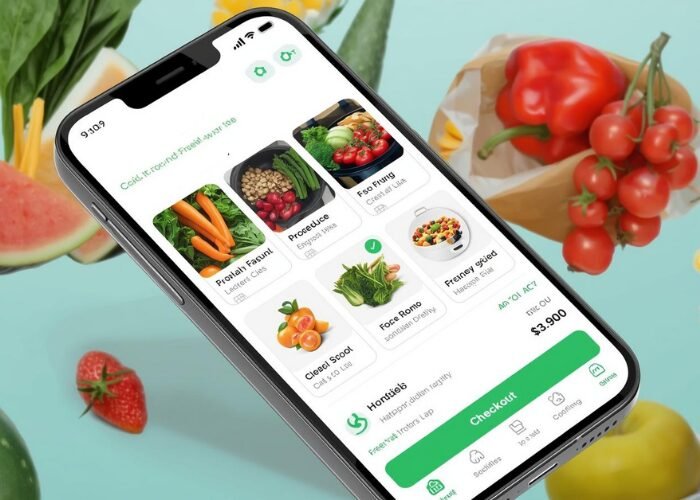
The way people shop for groceries is changing — and not just because of delivery. A quieter revolution is happening through the microphone. Voice search, once the novelty feature of smart speakers, has matured into a genuinely practical tool that millions of shoppers are using to fill their carts, reorder essentials, and track deliveries — all without typing a single character.
For any grocery delivery app development company building the next generation of shopping platforms, voice search is no longer optional. It is the kind of feature that separates apps people use from apps people love.
This blog explores what voice search in grocery apps actually looks like, why it matters, how it works under the hood, and what developers and product teams need to know to build it well.
Why Voice Search Makes Sense for Grocery Shopping
Grocery shopping is a uniquely repetitive, list-driven activity. People buy the same 40 to 60 items week after week. They add items to their cart while cooking dinner, while their hands are covered in flour, while chasing a toddler, or while driving home from work. Typing in those moments is awkward, slow, or simply impossible.
Voice bridges that gap.
According to consumer behavior research, grocery shopping is among the top three use cases for voice assistants on mobile devices, sitting alongside weather checks and navigation. The reason is simple: shoppers already think in lists. “I need milk, eggs, pasta, and olive oil” is a sentence that comes naturally. Converting that into four separate typed searches in an app is friction. Speaking it takes two seconds.
For a best grocery delivery app development company, this insight is foundational. The goal is not to bolt on a voice button as a feature checkbox — it is to design the core shopping flow around the assumption that users may want to speak at any point.
Core Voice Search Features Grocery Apps Should Offer
1. Natural Language Product Search
The most basic voice feature is product search — the user taps a microphone icon and says what they want. But the difference between a good implementation and a great one lies in how well the app understands natural language rather than keyword strings.
A shopper might say “I want the organic Greek yogurt I bought last time” or “do you have low-sodium soy sauce?” A sophisticated natural language processing (NLP) layer needs to parse intent, identify the product category, apply relevant filters (organic, low-sodium), and optionally cross-reference purchase history — all in under two seconds.
This requires integration with a robust NLP engine such as Google’s Dialogflow, Amazon Lex, or OpenAI’s APIs, layered on top of the app’s product catalogue and search infrastructure. The grocery delivery app development company building this system must ensure the NLP layer is trained specifically on grocery vocabulary — including brand names, regional product names, dietary terms, and colloquialisms.
2. Voice-Activated Cart Management
Beyond search, shoppers want to manage their cart by voice. This means commands like “add two pounds of chicken breast to my cart,” “remove the chips I just added,” or “change the quantity of apples to six.”
This feature requires a conversational state engine — the app needs to remember context from one command to the next. If a user says “actually make that three pounds,” the system must understand what “that” refers to. This is a significantly harder engineering problem than one-shot voice search, and it is where many early implementations fall short.
The payoff, however, is enormous. Cart management by voice dramatically reduces session length and friction, particularly on mobile where typing quantities and adjusting items is cumbersome.
3. Voice-Driven Reordering
Reorder functionality is one of grocery apps’ most powerful retention tools. A significant proportion of grocery purchases are habitual — the same products, the same quantities, week after week.
Voice makes reordering effortless. Phrases like “reorder my usual weekly shop,” “add everything from my last order,” or “reorder the items I buy every month” can trigger intelligent reorder flows. The app surfaces the previous basket, allows quick voice confirmation or modification, and moves straight to checkout.
For the grocery delivery app development company, this feature requires clean purchase history APIs and a voice intent model that maps reorder commands accurately. The UX design challenge is allowing the user to confirm, tweak, and override suggestions with additional voice commands rather than forcing them to switch to touch.
4. Voice-Based List Creation
Shoppers often maintain running lists — things they notice have run out during the week. Voice list creation allows users to add items to a shopping list throughout the week in a completely hands-free way: “add dishwasher tablets to my shopping list,” “remind me to buy more coffee,” “I’m out of ketchup.”
This feature often integrates with voice assistants at the OS level — both iOS Siri Shortcuts and Android Google Assistant support custom app integrations, allowing users to add items to their grocery list from a home screen widget or even from a smart speaker without ever opening the app.
Building this requires deep linking, background services, and platform-specific integrations — a meaningful development investment, but one that creates a powerful daily-use habit loop for the app.
5. Conversational Recipe-to-Cart
One of the more advanced and genuinely exciting voice features emerging in premium grocery apps is recipe-driven shopping. A user says “I want to make spaghetti bolognese this weekend” and the app responds by listing the ingredients needed, confirming which ones the user already has (if the app has pantry tracking), and adding the rest to the cart — all through a voice-guided conversation.
This feature requires integration with a recipe database or AI model, inventory awareness, and a multi-turn conversational flow. For a grocery delivery app development company looking to differentiate its product, this is the kind of feature that generates press coverage, app store reviews, and genuine word-of-mouth.
The Technology Stack Behind Grocery Voice Search
Building voice search for a grocery app involves several distinct technical layers working in concert.
Automatic Speech Recognition (ASR) converts spoken audio into text. Leading providers include Google Cloud Speech-to-Text, Apple’s SFSpeechRecognizer, and Mozilla DeepSpeech for on-device processing. The choice matters for accuracy with accents, background noise handling, and latency.
Natural Language Understanding (NLU) takes that transcribed text and extracts meaning — the intent (search, add to cart, reorder), entities (product name, quantity, brand, dietary requirement), and context (is this a follow-up to a previous command?). This is where most of the product intelligence lives.
Search and Catalogue Integration maps the understood intent to actual products in the app’s database. This requires fuzzy matching, synonym libraries, and relevance ranking that accounts for the user’s location, purchase history, and available inventory.
Text-to-Speech (TTS) is the output layer — when the app responds verbally to confirm actions or ask clarifying questions, TTS converts the response to natural-sounding audio. This is critical for hands-free usability, particularly when the user’s screen may not be visible.
On-Device vs. Cloud Processing is an important architectural decision. Cloud-based ASR offers superior accuracy but requires network connectivity and introduces latency. On-device processing (increasingly viable with models like Whisper running on modern mobile hardware) offers speed and works offline. A grocery delivery app development company building for global markets needs to consider network variability and design graceful fallbacks.
Accessibility and Inclusivity: A Quiet Superpower
Voice search is often discussed as a convenience feature, but its impact on accessibility is profound and sometimes underappreciated.
For users with visual impairments, motor difficulties, dyslexia, or limited literacy, voice interaction can transform a grocery app from inaccessible to genuinely empowering. Elderly users who struggle with small touch targets and dense interfaces often find voice interaction significantly more comfortable.
Grocery delivery apps that build truly robust voice features — including clear audio feedback, support for slower speech, and tolerance for non-native accents — open their service to a much broader user base. For a grocery delivery app development company pitching to enterprise clients or retail chains, accessibility compliance is increasingly a procurement requirement, not a nice-to-have.
Designing for voice with accessibility in mind also tends to make the feature better for everyone. A system that handles accented speech well, speaks responses clearly, and allows generous pauses between commands is simply a better voice interface for all users.
Common Pitfalls to Avoid
Despite the promise, voice search in grocery apps frequently fails users in predictable ways. Here is what a grocery delivery app development company should be careful to avoid:
Poor acoustic modeling for ambient noise. Kitchens are loud — blenders, running water, children, televisions. Voice search that fails in a kitchen has failed in the most critical grocery shopping environment. Testing must include real-world acoustic conditions.
Rigid command structures. Voice search that only works when users phrase things exactly right (“add milk to cart” works, “I need milk” doesn’t) will frustrate users and see the feature abandoned. Invest in robust NLU that handles natural variation.
No fallback to text. Voice is a modality preference, not a mandate. When voice fails — whether due to noisy environments, speech difficulties, or user preference — the transition to text search should be seamless and instantaneous.
Ignoring multilingual users. In diverse markets like India, the United States, or the United Kingdom, a significant proportion of users may prefer to speak in a language other than English, or may code-switch between languages in a single sentence. Grocery apps serving multilingual populations need voice models trained accordingly.
Privacy theatre over real privacy. Users are increasingly aware of microphone permissions and data practices. Apps that record voice data without transparency, or that activate the microphone passively, erode trust rapidly. A grocery delivery app development company should invest in clear consent flows, local processing where possible, and explicit data retention policies.
The Competitive Landscape and Market Signals
Major players have already moved. Amazon’s Alexa integration with Amazon Fresh allows customers to add items by voice through smart speakers as well as within the app. Instacart has piloted conversational search features. Walmart’s app allows voice-driven list creation through Google Assistant integration.
These are signals, not anomalies. The grocery delivery market is increasingly competitive, and differentiation at the UX layer — faster, smarter, more natural interaction — is one of the few dimensions where newer entrants can compete against established players with larger catalogue advantages.
For a grocery delivery app development company working with retail clients, voice search is fast becoming a standard capability expectation alongside real-time inventory, scheduled delivery slots, and loyalty programme integration.
Building Voice Search: Where to Start
For development teams approaching this for the first time, a phased rollout makes sense:
Phase 1 — Basic voice-to-search: single-turn voice input that populates the search bar, using a well-tested ASR provider. Low engineering cost, immediate user value.
Phase 2 — Voice cart commands: add and remove items by voice with simple quantity management. Requires NLU integration and session context.
Phase 3 — Conversational reordering and list management: multi-turn voice flows with purchase history integration.
Phase 4 — Advanced use cases: recipe-to-cart, pantry awareness, personalised voice recommendations.
Each phase delivers user value independently and generates the usage data needed to improve the models for the next phase.
Conclusion
Voice search in grocery delivery apps is not a futuristic concept — it is a present-day competitive differentiator that reshapes how people interact with the shopping experience. It reduces friction, improves accessibility, creates daily-use habit loops, and positions an app as genuinely modern in a crowded market.
For any grocery delivery app development company building or upgrading a grocery platform, the investment in voice capabilities pays dividends in user retention, session frequency, and brand perception. The technology is mature enough to implement reliably. The user demand is clearly there. The question is no longer whether to build voice search — it is how quickly and how well.
The apps that get this right will not just make shopping faster. They will make it feel effortless — and that is the kind of experience users come back to every single week. In a market where loyalty is hard-won and churn is constant, that effortlessness is not a small thing. It is the entire game. Voice search, built thoughtfully and iterated upon consistently, is one of the clearest and most proven paths to earning it.
Read Also: What Are the Latest Technologies Used in Mobile App Development | Selecting management help services for your academics
