
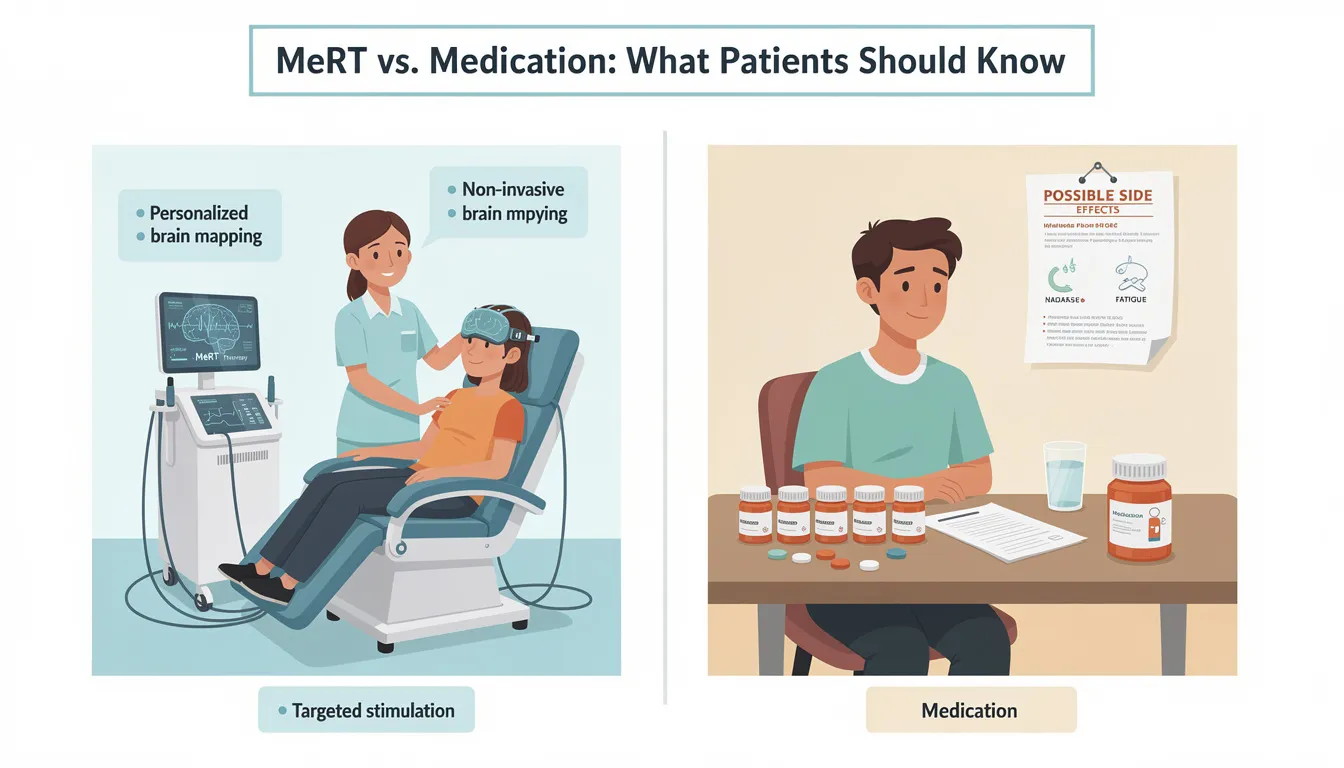
With years of experience in exploring advanced neurotherapies, I have come to the conclusion that when patients search for “MeRT vs medication,” “Is MeRT better than antidepressants?” or “drug-free treatments for depression,” they’re usually at a critical decision point in life.
It indicates that they’ve either tried medication without success or want a safer and more targeted alternative that does not cause any other health issues. This is not just a treatment comparison but a shift in how people want to understand brain health. Research shows that medication works chemically, but MeRT works neurologically. How? You ask? The answers are right here.
This blog will clearly break down both approaches, answer the most commonly asked questions from patients, and help you understand what actually matters when choosing between MeRT vs. medication.
What is MeRT Therapy and How Does It Work?
Starting with one of the most asked questions, that is, “What is MeRT therapy?”
MeRT, or Magnetic e Resonance Therapy, is a non-invasive brain stimulation treatment that uses magnetic pulses to regulate brain activity. It is built on the foundation of Transcranial Magnetic Stimulation but adds a crucial layer of personalization. Here is how it works:
-
qEEG brain mapping
A qEEG brain map measures your brainwave activity while you are at rest. Small sensors are placed on the scalp to record electrical signals, which are then analyzed to create a detailed map of how different areas of the brain are functioning and communicating with each other.
-
Data-based targeting
The collected data is reviewed to identify areas of dysregulation, such as regions that are overactive, underactive, or not properly synchronized. These patterns help clinicians understand where the brain may not be functioning optimally.
-
Personalized treatment delivery
Based on this analysis, a treatment plan is created that is specific to the patient. This includes selecting the exact frequency of stimulation, the precise location on the brain to target, and the timing of the pulses to match the brain’s natural rhythms.
-
Brain stimulation support
During each session, magnetic pulses are delivered to the targeted areas of the brain. These pulses are designed to gently encourage more balanced brain activity over time, helping the brain move toward more stable and efficient functioning.
Unlike standardized treatments, MeRT adapts to the patient’s unique brain patterns. From a clinical perspective, this personalization is where MeRT stands apart. No two brains function the same way, so treating them identically often limits outcomes.
How Do Antidepressant Medications Work?
Another core query that we often get is, “How do antidepressants work?”
Here is what they do: medications target brain chemistry, specifically neurotransmitters like serotonin, dopamine, and norepinephrine. These drugs aim to correct chemical imbalances linked to depression and anxiety. However, there is an important clinical reality many patients are unaware of, let’s have a read at that.
Response varies by patient
Medication does not work the same way for everyone. Some patients notice clear improvement, while others experience only partial relief or no meaningful change at all. That variation is one reason medication outcomes can be difficult to predict at the start of treatment.
Trial and error is common
Many patients go through a trial-and-error process before finding the right medication or dosage. One prescription may cause unwanted side effects, while another may not provide enough symptom relief. As a result, treatment can take time and often requires ongoing adjustments.
Severity can shape results
Medication may show stronger benefits in patients with more severe symptoms than in those with mild to moderate cases. This is one reason treatment plans often need to be matched carefully to the patient’s overall condition, history, and symptom level.
In practice, this means medication is not a precision solution. It is a generalized approach to a highly individualized problem.
MeRT vs Medication: What is the Core Difference?
One more common question our patients frequently ask is, “What is the difference between MeRT and medication?”
Here is the simplest way to understand it:
Medication treats brain chemistry.
MeRT targets brain function and electrical activity.
Let’s break this down clinically:
Medication approach
Medication alters neurotransmitter levels, creates a systemic effect across the brain, and is not targeted to specific neural circuits.
MeRT approach
MeRT targets specific brain regions, is based on real-time brainwave data, and uses a personalized treatment protocol.
This difference is critical. Medication changes how the brain feels. MeRT aims to change how the brain functions.
Is MeRT More Effective than Medication?
Now, if you ask me, “Is MeRT more effective than antidepressants?”, I might not have the correct answer, but the honest answer is nuanced. Here is how,
Effectiveness of Medication
Medication works for many patients, is often used as a first-line treatment, and can lose effectiveness over time.
Effectiveness of MeRT and Brain Stimulation
TMS-based therapies show meaningful response rates, and MeRT has attracted attention for its personalized approach.
In many clinical settings, brain stimulation therapies are used after medication fails, which already suggests their role in more complex cases. However, it is important to understand:
Research maturity differs
MeRT is newer and has less large-scale clinical validation compared to TMS.
Stronger fit for certain patients
From experience, MeRT tends to show stronger results in treatment-resistant depression, neurological conditions, and patients who do not tolerate medication.
What are the Side Effects of MeRT vs Medication?
Patients often ask, “Is MeRT safer than medication?”
Medication side effects
Medication side effects can include weight gain, sexual dysfunction, emotional numbness, sleep disturbances, and withdrawal-related issues.
MeRT side effects
MeRT side effects are usually milder and may include scalp discomfort or a temporary headache.
From a risk perspective, MeRT is often preferred by patients seeking a drug-free alternative.
Who Should Choose MeRT Over Medication?
A common search query is, “Who is a good candidate for MeRT?” and it is rightly asked.
Well, based on clinical patterns, MeRT is often suitable for:
-
Patients with treatment resistance
People who have not improved with standard medication protocols may benefit from a more targeted neurological approach.
-
Patients with medication sensitivity
Individuals who cannot tolerate medication side effects often look to MeRT as an alternative.
-
Patients seeking non-drug options
Some people want treatment without relying on daily medication.
-
Patients with complex neurological needs
Those with PTSD, TBI, cognitive issues, or sleep-related concerns may also explore MeRT.
Medication, on the other hand, is often recommended for:
-
First-line symptom management
Medication may still be appropriate for first-time depression cases, mild to moderate symptoms, or situations requiring immediate symptom control.
Does MeRT Replace Medication Completely?
Another important query that I often get is, “Can MeRT replace antidepressants?”
The answer is not always. In clinical practice, treatment strategies often fall into three categories, given below.
-
Medication only
Some patients do well with medication as their primary treatment.
-
MeRT only
Others choose MeRT as a standalone path, especially when they want a non-drug option.
-
Combination therapy
Some patients benefit from using both approaches together, especially when symptoms are severe or when faster stabilization is needed.
However, a growing number of patients are choosing MeRT as a standalone option to avoid long-term medication use.
How Long Does MeRT Take Compared to Medication?
Now, after all the answered questions, one more important query that is asked by almost every person is, “How long does MeRT take to work?”
Here is a simple comparison of the two, along with timings for MeRT.
Medication timeline
Medication may take several weeks before patients notice a meaningful change, and it often requires ongoing use.
MeRT timeline
MeRT also follows a structured treatment schedule over several weeks, but its goal is to support long-term neurological improvement.
The difference lies in sustainability. Medication often requires indefinite continuation. MeRT aims to create lasting neurological changes.
Is MeRT FDA Approved Like Medication?
Patients often ask: “Is MeRT FDA approved?”
Here’s the clarity:
TMS has FDA recognition
TMS is FDA approved for depression.
MeRT is more personalized
MeRT is generally viewed as a more personalized approach built on TMS principles.
Standardization is still evolving
MeRT itself has less regulatory standardization, which means patients should ask detailed questions about protocol, provider training, and treatment planning.
This does not mean it is unsafe. It means it is still evolving as a clinical protocol.
Why are More Patients Choosing MeRT Today?
According to the recent search trends, people show rising interest in “drug-free depression treatment” and “alternatives to antidepressants.”
Here’s why MeRT is gaining attention out of the entire situation,
-
Personalized treatment
Patients are drawn to an approach based on their own brain activity.
-
Non-invasive care
MeRT does not require surgery or sedation.
-
Minimal side effects
Many patients value the lower side effect burden compared to medication.
-
Long-term potential
MeRT may support more lasting functional improvement for the right patient.
Patients today are more informed. They are no longer just asking what works. They are asking what works for them.
What Should Patients Consider Before Choosing?
The most important question patients ask is, “How do I choose between MeRT and medication?” The answer depends on several key factors that should be evaluated carefully.
Severity of symptoms
The intensity of symptoms plays a major role in treatment decisions. In cases of severe depression or acute distress, medication may be recommended first to help stabilize symptoms more quickly. MeRT may still be considered, but timing and urgency often guide the initial approach.
Past treatment history
A patient’s history with medication is critical. If medications have provided limited relief or have stopped working over time, MeRT becomes a more relevant option. Patients who have already gone through multiple prescriptions without success are often strong candidates for a more targeted approach.
Tolerance to side effects
Side effects can significantly impact daily life. If medication causes issues such as fatigue, emotional blunting, or physical discomfort, it may not be sustainable long-term. In these cases, exploring alternatives like MeRT can help reduce that burden.
Long-term goals
Patients should consider what they want from treatment. Some are looking for short-term symptom relief, while others want greater, long-term improvement in focus, mood regulation, and overall brain function. This distinction often shapes whether medication, MeRT, or a combination is the right path.
Access and cost
Practical factors also matter. Medication is typically more accessible and often covered by insurance. MeRT, on the other hand, may involve out-of-pocket costs and requires access to a specialized provider. Understanding these realities helps set clear expectations before starting treatment.
Final Thoughts: MeRT vs Medication
The question is not which treatment is better. The question is which treatment is right for you.
Medication has helped millions of patients and remains a valuable tool. But it is not always enough.
MeRT represents a shift toward precision brain therapy, where treatment is guided by how your brain actually functions, not just how symptoms appear.
If you are exploring options beyond medication or want a more targeted approach, MeRT is worth serious consideration.
FAQs
Is MeRT better than antidepressants?
It depends on the patient. MeRT may offer better outcomes for treatment-resistant cases, while medication is often effective as a first-line treatment.
Does MeRT cure depression?
No treatment guarantees a cure, but MeRT aims to improve brain function, which can lead to long-term symptom relief.
Can I do MeRT while on medication?
Yes, many patients combine both under medical supervision.
Is MeRT painful?
No, it is non-invasive and generally well tolerated.
How long does a MeRT treatment program typically last?
Most MeRT programs run 4 to 8 weeks, with daily sessions Monday through Friday. The exact duration depends on the individual’s response to treatment and the condition being addressed.
How is MeRT different from standard TMS therapy?
While both use magnetic stimulation, MeRT is personalized using EEG and EKG data to target each patient’s unique brainwave patterns, whereas traditional TMS uses a one-size-fits-all frequency protocol.
Who is a good candidate for MeRT?
MeRT is particularly beneficial for individuals with treatment-resistant depression, PTSD, traumatic brain injury, autism spectrum disorder, or those who have not responded well to medications or traditional therapies.
Are the effects of MeRT long-lasting?
Many patients report sustained improvements months after completing treatment. However, some may require maintenance sessions to preserve results, especially during periods of high stress.
How soon will I notice results from MeRT?
Some patients report improvements within the first 1 to 2 weeks, while others may notice gradual changes over the full course of treatment. Progress is regularly monitored through follow-up EEG assessments.
Is MeRT covered by insurance?
Coverage varies by provider and location. MeRT is still considered emerging technology in many regions, so it is often not fully covered. Patients are advised to check directly with their insurance carrier.
Are there any side effects associated with MeRT?
MeRT is generally well tolerated. Some patients experience mild headaches or scalp discomfort during early sessions, but these effects are typically temporary and resolve quickly.
What conditions besides depression can MeRT treat?
MeRT has been explored as a treatment for PTSD, anxiety, autism spectrum disorder, cognitive decline, traumatic brain injury, sleep disorders, and certain neurodevelopmental conditions.
Do I need a referral to start MeRT treatment?
Requirements vary by clinic and country. Some centers accept self-referrals, while others require a referral from a psychiatrist or neurologist. It is best to contact a MeRT provider directly to understand their intake process.
What happens during a typical MeRT session?
Each session generally lasts 30 to 45 minutes. A technician places a magnetic coil near specific areas of the scalp, delivering gentle magnetic pulses in patterns customized to the patient’s brainwave data. The patient remains awake and seated throughout.

Mark John is an experienced article publisher with a strong background in digital media, SEO writing, and content strategy. Skilled in creating engaging, well-researched, and reader-focused articles that drive traffic and build authority. Passionate about delivering high-quality content across diverse niches, maintaining editorial standards, and optimizing every piece for maximum reach and impact.