
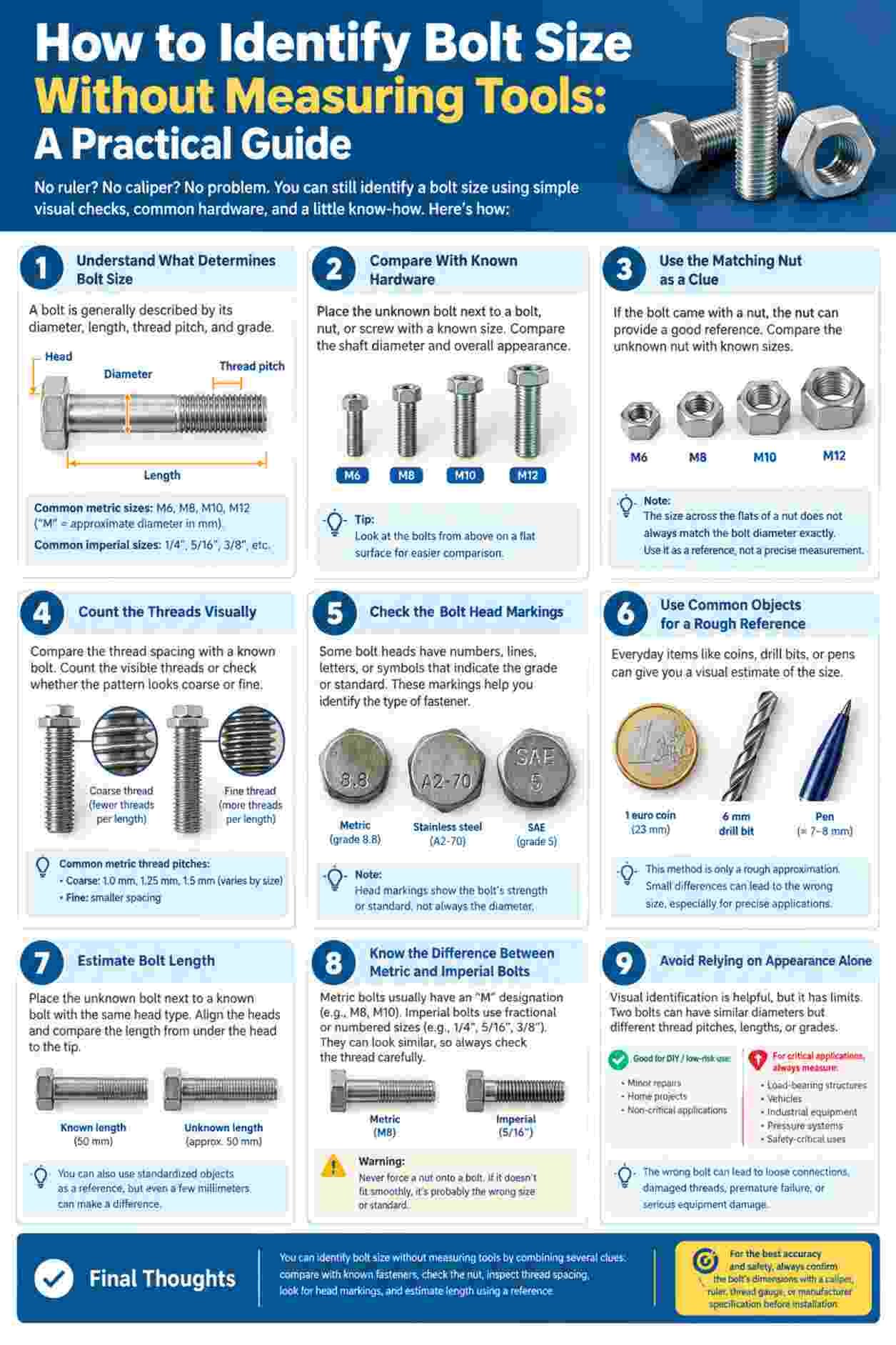
Knowing the correct bolt size is essential for repairs, construction, automotive work, machinery maintenance, and many DIY projects. Normally, a ruler, caliper, or thread gauge makes bolt identification much easier. However, there are situations where measuring tools are not available. Fortunately, you can still estimate and identify a bolt size by using visual comparisons, existing hardware, and basic knowledge of bolt dimensions.
This practical guide explains several simple ways to identify bolt size without specialized measuring tools while helping you avoid common mistakes. These methods are especially helpful in workshops, garages, and home projects when replacement hardware must be identified quickly before purchasing or installing replacement hardware with confidence and safely. Having a basic identification method can save time when sorting mixed fasteners, choosing replacement hardware, or preparing maintenance work, especially when labels, packaging, and original specifications are unavailable during routine repairs too.
Understand What Determines Bolt Size
Before identifying a bolt, it helps to understand the basic measurements that define its size. A bolt is generally described by its diameter, length, thread pitch, and sometimes its grade.
The diameter refers to the thickness of the bolt shaft. Length is typically measured from underneath the bolt head to the end of the threaded section. Thread pitch describes the distance between individual threads.
Metric bolts are commonly identified using sizes such as M6, M8, M10, or M12. The number represents the approximate nominal diameter in millimeters. Imperial bolts, commonly used in some markets, may be identified by fractions or numerical sizes such as 1/4-inch, 5/16-inch, or 3/8-inch.
Understanding these characteristics gives you a useful starting point even when measuring tools are unavailable.
Compare the Bolt With Known Hardware
One of the easiest methods is to compare the unknown bolt with a bolt, nut, or screw whose size you already know.
For example, if you have a known M8 bolt, place it next to the unknown bolt and compare the shaft diameters. If the unknown bolt appears slightly thinner, it may be an M6 bolt. If it looks noticeably thicker, it could be an M10 or larger.
The comparison works best when the reference hardware is placed side by side on a flat surface. Looking at the bolts from directly above can also make differences in diameter easier to see.
Keep in mind that visual comparison only provides an estimate. Small differences between nearby sizes can be difficult to recognize without actual measuring equipment.
Use the Matching Nut as a Clue
If the bolt came with a nut, the nut can provide valuable information. A properly matched nut should fit smoothly onto the bolt threads.
You can compare the unknown nut with nuts of known sizes. For example, if the unknown nut appears similar to a known M10 nut, there is a good chance that the bolt is also an M10.
However, the size across the flats of a nut does not always directly correspond to the bolt diameter. Different standards and bolt grades can use different head or nut dimensions. Therefore, use the nut primarily as a reference rather than treating its outside dimensions as an exact measurement.
Count the Threads Visually
Thread pitch is another important part of bolt identification. Without a thread pitch gauge, you can still compare the unknown bolt against a bolt with a known thread pattern.
Place both bolts next to each other and examine the threads carefully. If the spacing looks identical over the same length, they may have the same pitch.
You can also count the number of visible threads across a similar section of two bolts. This method is particularly useful when distinguishing between coarse and fine threads.
For metric bolts, common coarse thread pitches include 1.0 mm, 1.25 mm, and 1.5 mm, depending on the bolt diameter. Fine-thread versions may have smaller spacing.
Because thread differences can be subtle, use this technique together with other identification methods.
Use the Bolt Head Markings
Bolt heads often contain markings that provide useful information. Some bolts have numbers, lines, letters, or manufacturer symbols stamped into the head.
These markings may indicate the bolt’s strength or grade rather than its physical size. For example, metric and SAE fasteners use different marking systems. A bolt marked with strength information can therefore help identify its standard, but it does not necessarily tell you the diameter.
Still, head markings can help distinguish one type of fastener from another and prevent you from mixing bolts with different specifications.
Compare With Common Objects
When no known bolts are available, everyday objects can sometimes provide a rough reference.
For example, a standard coin, drill bit, pen, or other familiar object can give you a visual size comparison. Place the bolt beside the object and estimate its diameter.
This technique should only be considered a rough approximation. Everyday objects are not manufactured as precision measuring references, and small differences can lead to selecting the wrong fastener.
For important structural, automotive, or machinery applications, visual estimation should always be confirmed with proper measuring equipment before installation.
Determine Bolt Length Without a Ruler
Bolt length can also be estimated by comparing the unknown bolt with another bolt of known length.
Place the bolts side by side with their heads aligned. Compare the distance from the underside of each head to the bolt tip. This can provide a reasonable approximation of the unknown bolt’s length.
You can also use objects with standardized dimensions as rough references, but remember that even a few millimeters can matter in applications where bolt engagement is critical.
Know the Difference Between Metric and Imperial Bolts
Another important step is determining whether the bolt is metric or imperial. Metric bolts are usually identified using an “M” designation, such as M8 or M10. Imperial bolts may use fractional inch sizes or numbered sizes.
Metric and imperial bolts can sometimes look remarkably similar. A nut may start threading onto the wrong bolt but quickly become tight or fail to engage properly. Never force a nut onto a bolt simply because it appears close in size.
When in doubt, test the thread carefully and compare it with known hardware from the same system.
Avoid Relying on Appearance Alone
Visual identification is useful, but it has limitations. Two bolts can have similar diameters while having different thread pitches. Likewise, bolts with similar lengths may have different grades, materials, or thread standards.
For low-risk DIY applications, visual comparison may help you find a suitable replacement. For load-bearing structures, vehicles, industrial equipment, pressure systems, or safety-critical applications, accurate measurement and specification checking are strongly recommended – How to Choose an Industry-Relevant Marketing Dissertation.
Using the wrong bolt can lead to loose connections, damaged threads, premature failure, or even serious equipment damage.
Final Thoughts
Identifying bolt size without measuring tools is possible when you combine several clues. Compare the bolt with known fasteners, examine the matching nut, inspect thread spacing, check head markings, and estimate length using a known reference.
The key is not to depend on a single visual clue. Combining diameter, length, thread pattern, and fastener standards gives you a much better chance of identifying the correct bolt.
However, these methods should be treated as practical estimates rather than precision measurements. Whenever accuracy and safety are important, confirm the bolt’s dimensions with a caliper, ruler, thread gauge, or manufacturer specification before installation. Choosing the correct fastener is a small step that can make a major difference in the reliability and safety of any project.
Also Read: How Can You Improve Your NVQ Level 2 work Before Submission?